← Home · Excavations

Geotechnical Analysis for Soft Soil Tunnels in Kelowna

Together, we solve the challenges of tomorrow.

DETAILS →

The first thing we mobilize on a soft ground tunnel job in Kelowna isn't a drill rig—it's a CPT truck with a 20-tonne reaction system and seismic piezocone. The Okanagan Valley floor, shaped by glacial Lake Penticton sedimentation, gives us sequences of silty clay and fine sand that can change stiffness over less than two meters of depth. We've learned that standard split-spoon samples alone don't capture the undrained shear strength profile with the resolution needed for closed-face TBM selection. In our experience, pairing CPTu data with triaxial consolidated-undrained tests on undisturbed Shelby tube specimens gives the design team a defensible basis for face pressure calculations. The city sits at roughly 344 meters elevation, and the water table in the valley bottom often sits within three meters of ground surface—a reality that drives dewatering strategy and lining design from day one of the investigation.

Soft ground tunneling in the Okanagan isn't about finding rock—it's about understanding how quickly the clay loses strength after disturbance.

Method and coverage

What we see repeatedly in Kelowna is that the upper five to twelve meters of soil behave as normally consolidated to lightly overconsolidated lacustrine clay, with sensitivity values that can exceed 4 in the Mission Creek fan area. This matters because tunnel crown stability in these materials depends less on peak strength and more on post-peak softening behavior. Our laboratory program typically covers Atterberg limits, one-dimensional consolidation with constant-rate-of-strain loading, and in-situ permeability testing via falling-head piezometer methods to define the hydraulic conductivity profile. A full grain-size analysis—including hydrometer—is essential here; the silt fraction often controls the transition between drained and undrained loading during excavation. We report all data against ASTM D2487 for classification and ASTM D4767 for triaxial parameters, ensuring the ground model aligns with both NBCC 2015 seismic provisions and the contractor's means-and-methods planning.
Geotechnical Analysis for Soft Soil Tunnels in Kelowna
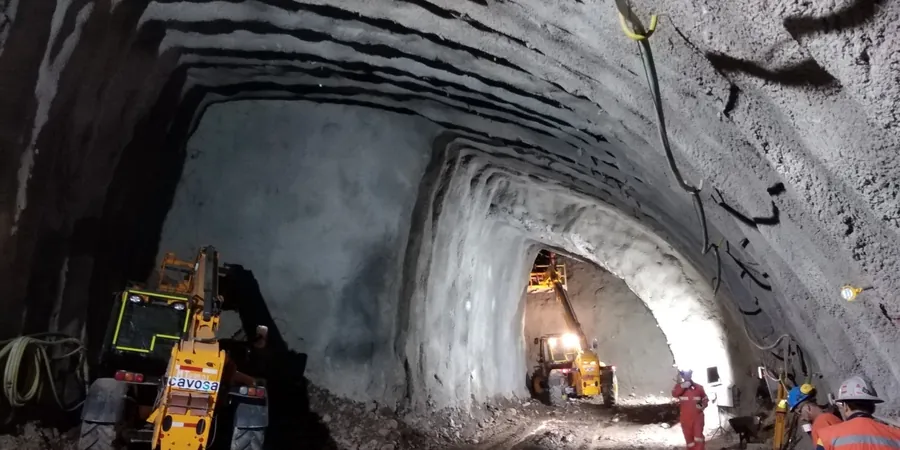
Technical reference image — Kelowna

Regional considerations

We were called to review a microtunnel installation near downtown Kelowna where the drive crossed beneath a four-lane arterial with less than two diameters of cover. The contractor had assumed undrained behavior based on a desk study, but the actual clay contained enough silt laminations—barely visible in the cuttings—to allow partial drainage during the stoppages for pipe changes. Settlement measured at the pavement surface reached 45 millimeters in 72 hours. The root cause was a ground model that hadn't distinguished between matrix permeability and mass permeability. In our subsequent investigations for similar alignments, we now specify in-situ dissipation tests at multiple horizons and run consolidated-undrained triaxial with pore pressure measurement to confirm whether contractive or dilative behavior governs at working strain rates. That one case reshaped how we approach soft ground tunnel analysis in Kelowna.

Need a geotechnical assessment?

Reply within 24h.

Email: contact@geotechnicalengineering.xyz

Technical parameters


ParameterTypical value
Undrained shear strength (su)15–60 kPa typical valley clay
Sensitivity (St)2–6, locally higher near Mission Creek
Liquidity Index0.8–1.2 (soft to firm consistency)
Hydraulic conductivity (kv)1×10⁻⁷ to 5×10⁻⁹ m/s
Overconsolidation ratio (OCR)1.0–2.5 in upper 10 m
Compression index (Cc)0.25–0.45
Plasticity index (PI)10–35%

Complementary services

01

Pre-Construction Ground Characterization for Soft Ground Tunnels

Integrated CPTu, seismic piezocone, laboratory triaxial and consolidation testing, and in-situ permeability measurements designed to build a geotechnical baseline report that captures Kelowna's variable lacustrine clay profile and shallow groundwater conditions.

02

Tunnel Face Stability and Settlement Risk Assessment

Analysis of undrained and drained face pressures, short-term and long-term ground loss estimates, and surface settlement trough predictions tied to local stratigraphy and sensitivity values observed in the Mission Creek fan deposits.

Standards that apply


ASTM D4767-11: Consolidated Undrained Triaxial Compression Test, ASTM D2487-17: Unified Soil Classification System, NBCC 2015 Seismic Provisions (Site Class D/E)

Common questions

What geotechnical parameters matter most for soft ground tunnels in Kelowna?

Undrained shear strength, sensitivity, and hydraulic conductivity control the majority of design decisions. Kelowna's lacustrine clays often have sensitivity values between 2 and 6, which means the post-peak strength loss during excavation can be significant. We also focus on the coefficient of consolidation because partial drainage during tunnel advance affects face pressure estimates.

How deep are the soft clays in the Okanagan Valley floor?

In the central Kelowna area, soft to firm clays typically extend to depths between 15 and 40 meters, underlain by dense glacial till or bedrock. The depth varies considerably across the valley; near the airport the clay is thinner, while closer to the lake and Mission Creek fan the soft deposits can be thicker and more sensitive.

What is the typical cost range for a geotechnical investigation for a soft ground tunnel in Kelowna?

A comprehensive investigation program including CPTu, boreholes with Shelby tube sampling, laboratory testing, and reporting generally falls between CA$5,870 and CA$22,160, depending on the number of test locations, depth of exploration, and complexity of the laboratory program required.

Do you provide the Geotechnical Baseline Report (GBR) or just the factual data?

We deliver both the factual ground investigation report and the interpretive geotechnical baseline report. The GBR is prepared for use in design-build contracts and defines the baseline conditions against which the contractor measures differing site conditions—critical for risk allocation in soft ground tunneling under Canadian contracting practice.

How do you account for seismic loading on tunnels in Kelowna?

We apply NBCC 2015 site classification procedures using shear wave velocity profiles from seismic CPT or downhole methods. For soft ground tunnels, the ovaling and racking deformations are evaluated using free-field ground strain estimates tied to the site class, with laboratory dynamic properties from resonant column or cyclic triaxial tests where liquefaction or cyclic softening is a concern.
Location and service area

We serve projects across Kelowna and its metropolitan area.

View larger map