← Home · Slopes & Walls

Active and Passive Anchor Design in Kelowna

Together, we solve the challenges of tomorrow.

DETAILS →

Kelowna’s expansion up the benches of the Okanagan Valley has pushed residential and commercial projects onto slopes that were once considered too difficult to develop. The local geology—glacial till draped over silty lacustrine deposits—creates a layered profile where retaining structures are not optional but mandatory for any cut deeper than a meter and a half. When the City of Kelowna approved the Pandosy Urban Centre plan, the increased density along Lakeshore Road triggered a wave of excavations where active and passive anchor design became the primary solution for permanent shoring. The site conditions vary dramatically: granite bedrock can be within two meters on the upper benches, or buried thirty meters deep under compressible silts near the lakeshore. This variability is why we treat every anchor design in Kelowna as a site-specific problem. A standard tieback detail from a Vancouver project simply does not transfer to the Okanagan without significant re-engineering. The bond length that works in glacial till at UBC will fail in the saturated silt lenses common in Kelowna’s Mission neighbourhood.

A properly designed anchor in Kelowna's silty till can hold 100 tons for fifty years—if the corrosion protection is specified for Okanagan groundwater chemistry.

Method and coverage

The most expensive mistake we see in Kelowna is contractors assuming a passive anchor block is just dead weight. A row of gravity blocks keyed into weathered bedrock on Knox Mountain behaves completely differently than a soldier pile wall with active tendons drilled through loose colluvium in the Upper Mission. In one project near the Kelowna General Hospital expansion, the original design called for a bonded length of six meters in a stiff clay till. Core samples taken during construction revealed a thin water-bearing silt seam at four meters, halving the effective bond zone and requiring a full redesign of the retaining wall anchor pattern. The fix involved switching to a post-tensioned bar anchor with a double corrosion protection system, which we re-verified through on-site pull-out testing. This is where the interaction between active anchor systems and slope stability analysis becomes critical: the global factor of safety depends on the anchor capacity being available at exactly the right depth, not just on paper. Kelowna’s freeze-thaw cycles add another layer of concern, because the upper two meters of soil can lose bond strength during spring thaw when the ground is saturated.
Active and Passive Anchor Design in Kelowna
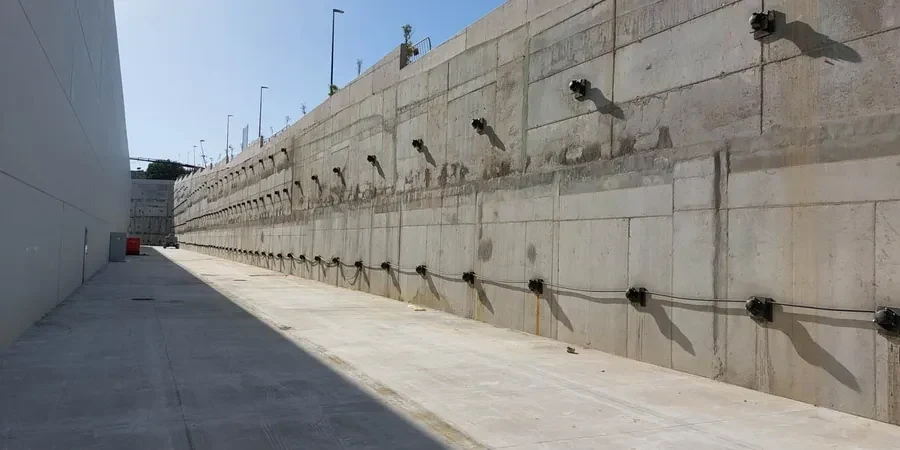
Technical reference image — Kelowna

Regional considerations

The drill rig we mobilize in Kelowna is a compact Klemm 806 with a rotary-percussive head, chosen because it can fit on residential lots in Glenmore and still punch through the cobbly till that blankets the valley. The real risk in anchor installation here is not the drilling itself—it is hitting an unmarked irrigation main or a perched water pocket. The Okanagan’s orchard history means dozens of old water lines crisscross the benchlands, and a high-pressure release into a drilled hole can blow out the grout column before it sets. We always run a GPR scan ahead of drilling on any property that was orchard within the last thirty years. Another Kelowna-specific risk is the presence of swelling clay seams in the till; a passive anchor block placed in these seams can heave after a wet winter, losing contact with the soil and reducing passive resistance to near zero. This is why our designs for Kelowna always include a drainage blanket behind passive blocks and a minimum embedment depth below the frost penetration line of 1.2 meters.

Need a geotechnical assessment?

Reply within 24h.

Email: contact@geotechnicalengineering.xyz

Process video


Technical parameters

ParameterTypical value
Design standardCSA A23.3 Annex G; PTI DC-35
Bond stress in glacial till40–120 kPa (preliminary); verified by field test
Typical anchor capacity range200 kN to 1,200 kN (strand or bar)
Corrosion protectionClass I (double encapsulation) for permanent anchors
Proof test load133% of design load (ASTM A416 strand)
Free length minimum4.5 m or as required to clear failure plane
Lock-off load70–100% of design load, depending on wall stiffness
Seismic adjustmentNBCC 2015 site class C/D; anchor load increased by 15–25%

Complementary services


01

Permanent Active Anchor Design

Post-tensioned strand or bar anchors for retaining walls, bridge abutments, and deep excavations in Kelowna. Includes bond length calculation in glacial till, double-corrosion protection detailing per PTI Class I, and seismic load adjustments per NBCC 2015.

02

Passive Anchor and Deadman Systems

Design of gravity blocks, soil nails, and tie-back walls for slope stabilization in Kelowna's residential bench developments. Includes passive wedge analysis, frost heave mitigation, and drainage integration for Okanagan silt soils.

Standards that apply

CSA A23.3-14 Annex G — Ground Anchors, PTI DC-35.1-14 — Recommendations for Prestressed Rock and Soil Anchors, ASTM A416/A416M-18 — Low-Relaxation Seven-Wire Steel Strand, NBCC 2015 — Seismic design provisions for anchor-supported structures

Common questions


How much does an active or passive anchor design cost in Kelowna?

Professional design fees for anchor systems in Kelowna typically range from CA$1,480 to CA$5,540 depending on the complexity of the site, the number of anchors, and whether pull-out testing supervision is included. A simple passive block detail for a small retaining wall sits at the lower end, while a multi-row active anchor design with corrosion protection and seismic analysis for a commercial excavation will be at the upper end.

What is the difference between active and passive anchors?

Active anchors are post-tensioned after grouting and locked off against the structure, applying a pre-compression to the soil or wall. They are used when deformation must be controlled tightly—think of a shoring wall next to an existing Kelowna building. Passive anchors develop their force only when the soil moves and engages the tendon, so they allow some displacement. We specify passive systems for slope stabilization where small movements are acceptable.

How does Kelowna's freeze-thaw cycle affect anchor performance?

Frost penetration in Kelowna reaches about 1.2 meters in exposed areas. The upper portion of a passive anchor block or the free length of an active anchor can experience reduced bond during spring thaw when the ground is saturated. We mitigate this by setting the bond zone below the frost line and specifying a drainage system behind the wall to prevent water buildup in the active zone.

Do I need a geotechnical investigation before anchor design?

Absolutely. Anchor design without site-specific soil data is guesswork. We need at minimum a borehole or test pit to identify the stratigraphy—glacial till, silt lenses, bedrock depth—and laboratory shear strength tests on undisturbed samples. Kelowna's geology changes within a single block, so we never rely on regional maps alone.
Location and service area

We serve projects across Kelowna and its metropolitan area. More info.

View larger map