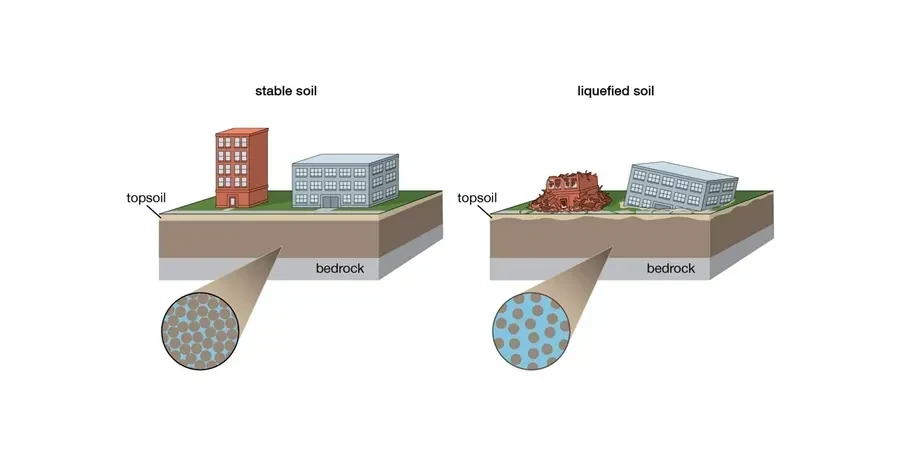
Kelowna sits at 344 m elevation on a mix of glacial lake sediments, fluvial sands, and silts deposited by the Okanagan Valley’s retreating ice. The 2020 NBCC places the city in a moderate seismic zone, but the real driver for a soil liquefaction analysis here is the high water table along the lakeshore and the loose granular lenses in the Rutland and Mission areas. We run the analysis combining field penetration data with lab cyclic testing when the project scope demands it. It is not about checking a box—it is about knowing whether your foundation soil turns to slurry during shaking. About 222,000 people live in the metro area, and with the city pushing densification near downtown and Pandosy, the exposure keeps growing.
For deeper profiles we pair the investigation with CPT testing to capture continuous tip resistance and friction ratio without disturbing the sample, and when shallow layers control the design we add test pits to log the stratigraphy and extract undisturbed blocks for the lab.
Liquefaction is not a yes-or-no question—it is a depth-by-depth calculation where a factor of safety of 1.1 means something very different than 0.8, especially under a mat foundation.
Method and coverage
On the east side of Okanagan Lake, we repeatedly see silty sand layers at 4 to 7 m depth that look firm during drilling but test below 15 blows on the SPT. That combination—low N-value plus silt content that slows drainage—is a classic liquefiable profile. Our analysis follows the NCEER/Youd-Idriss framework, updated with the Boulanger & Idriss (2014) triggering curves for fines content correction. We calculate a factor of safety against liquefaction for each critical layer and then estimate post-shaking settlement and lateral spread displacement using empirical charts calibrated for Western Canada seismicity.
When the site is close to the lake or Mission Creek, we also run a CPT-based liquefaction assessment because the cone picks up thin drainage paths that the SPT misses. The lab supports the field work with grain-size distributions, Atterberg limits, and cyclic direct simple shear on selected specimens. The output is a clear table of FS per layer and a settlement estimate you can hand to the structural engineer.
Regional considerations
The most common mistake we see in the Okanagan is running a standard bearing capacity report and skipping the liquefaction check because the site is not in Richmond or Victoria. Kelowna is not Vancouver—but it sits on the same Cordilleran deformation belt, and the NBCC 2020 assigns a PGA around 0.15–0.20 g for the city. That is enough to trigger pore pressure build-up in loose saturated sands. If the analysis is not done, the structural engineer designs for a soil that may lose 50% of its stiffness for 20 seconds. The result is differential settlement, cracked slabs, and in the worst case, a bearing failure under the column loads.
Even a one-storey commercial building on a shallow footing can tilt if the sand layer at 3 m liquefies and the crust above breaks. The cost of a soil liquefaction analysis is negligible next to the cost of underpinning a settled structure. And if the City asks for a peer review and you do not have the liquefaction chapter, you lose months.
Standards that apply
NBCC 2020 – National Building Code of Canada (seismic hazard values for Kelowna), NCEER/Youd-Idriss (2001) – Liquefaction resistance of soils (SPT-based procedure), Boulanger & Idriss (2014) – CPT and SPT liquefaction triggering procedures, ASTM D1586-18 – Standard Test Method for Standard Penetration Test (SPT), ASTM D5778-20 – Standard Test Method for Electronic Friction Cone and Piezocone Penetration Testing, ASTM D8296-19 – Standard Test Method for Consolidated Undrained Cyclic Direct Simple Shear
Common questions
Does the City of Kelowna require a liquefaction analysis for a building permit?
The City follows the BC Building Code, which references NBCC 2020. If the geotechnical investigation identifies loose saturated sands, the code requires a liquefaction assessment. For sites in Seismic Site Class C, D, or E—common along the lakeshore and creek corridors—the analysis is practically mandatory. We handle the submission package with the required site class determination and factor of safety tables.
What soil types in Kelowna are most susceptible to liquefaction?
Clean to silty sands with SPT N-values below 15, located below the water table. The post-glacial fluvial deposits along Mission Creek and the fine sands in the lower Rutland area are the typical candidates. Gravels are generally not liquefiable, and the clayey silt units that appear in some parts of Glenmore tend to be non-liquefiable but may undergo cyclic softening.
How much does a liquefaction study cost for a typical Kelowna lot?
A complete soil liquefaction analysis, including drilling, SPT sampling, lab index tests, and the engineering report, generally runs between CA$3,810 and CA$6,500. The range depends on the depth to refusal, the number of SPT blows, and whether CPT or cyclic lab testing is added. We provide a fixed quote after reviewing the site location and the proposed foundation type.
Can you use just a CPT without drilling for the analysis?
Yes, a CPTu-only liquefaction assessment is valid under NBCC 2020, and it is often the preferred method for mid-rise projects in Kelowna because it gives a continuous profile and detects thin drainage layers. We still recommend at least one SPT boring to calibrate the soil behavior type and collect samples for fines content, which the CPT-derived Ic cannot fully replace.
What happens if my site shows a factor of safety below 1.0?
We then move to the consequences: settlement and lateral spread. If the predicted settlement is under 25 mm and the structure tolerates it, a mat foundation with rigid reinforcement may suffice. For higher settlements, we propose Improvement—stone columns or vibro compaction—and re-run the analysis with the improved soil parameters. We deliver the options ranked by cost and schedule impact so the owner can decide.