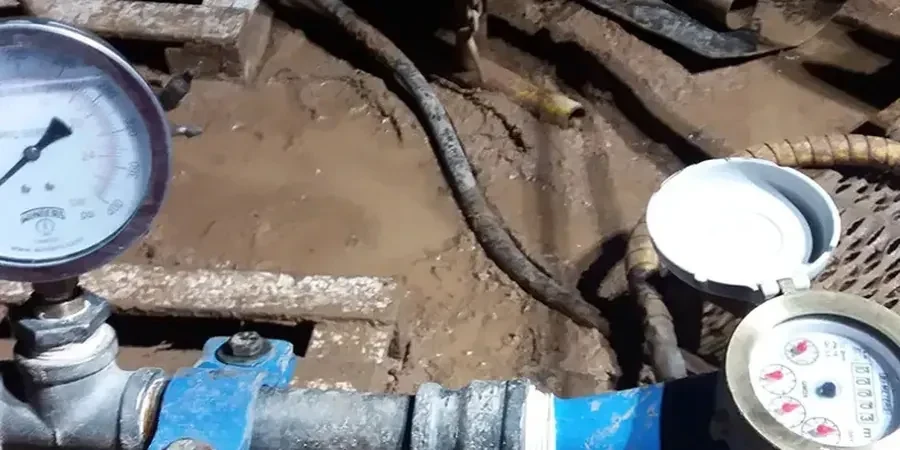
Kelowna's hydrogeology is a study in contrasts. Downtown sits on ancient glacial lake sediments—silts and clays that barely breathe—while the Upper Mission and Dilworth slopes are draped in coarse glaciofluvial gravels that can drain a pond in a day. Rainfall here averages barely 340 mm per year, but spring snowmelt from the Okanagan Highlands pushes groundwater levels up fast, especially near Mill Creek and Mission Creek. The practical consequence for any engineer is that a single desktop estimate of hydraulic conductivity won't cut it. A CPT soil profiling can map the stratigraphy, but to get mass permeability values that hold up under regulatory review, you need an in-situ Lefranc or Lugeon test done right, with variable-head and constant-head stages that match site conditions. Our team runs these tests in cased boreholes across the Central Okanagan, from lakeshore to benchland.
A single-stage Lugeon test without packer isolation can overestimate rock mass permeability by an order of magnitude in fractured Okanagan gneiss.
Regional considerations
Kelowna's bedrock—mainly Proterozoic gneiss and schist of the Shuswap Metamorphic Complex—weathers unpredictably. A Lugeon test that shows 3 Lugeon units at 15 m depth can jump to 25 units at 16 m if you hit an open joint set parallel to the Okanagan Fault. That kind of variation changes grout curtain design completely. In the overburden, the biggest risk is smearing along the borehole wall when augering through clay-rich till, which artificially depresses the Lefranc k-value by a factor of two or more. We counter this with careful flushing and, where the budget allows, a test pit excavation to visually inspect the test zone before backfilling. Ignoring these local effects leads to under-designed dewatering systems, slope drainage failures, or retaining wall weep holes that don't weep.
Common questions
What is the typical cost of a field permeability test in Kelowna?
Budget between CA$960 and CA$1,220 per test interval for a standard Lefranc or Lugeon setup, including digital data acquisition and a summary report. The final number depends on access, depth, and whether we need to mobilize a standalone water truck or can tap into an on-site supply.
When should I choose a Lugeon test over a Lefranc test?
Lugeon is the standard for rock masses once you're into competent bedrock—think gneiss or schist with fracture-controlled flow. Lefranc is appropriate for soil, decomposed rock, and fill where the test zone is granular or cohesive. If the material won't hold a packer seal, stay with Lefranc.
How long does a single test interval take in the field?
Plan on roughly 1.5 to 2.5 hours per interval once the borehole is drilled and cased. A variable-head Lefranc in silty sand might stabilize in 30 minutes, while a five-stage Lugeon in tight rock can run over two hours, especially if you wait for pressure equilibration between steps.
Do you handle the drilling or just the testing?
We can arrange the full package with a local driller who knows Kelowna's subsurface, or we can show up with our test gear and crew after your contractor has advanced the hole. Either way, we specify the casing depth, flush method, and standpipe installation so the test zone isn't compromised before we get there.