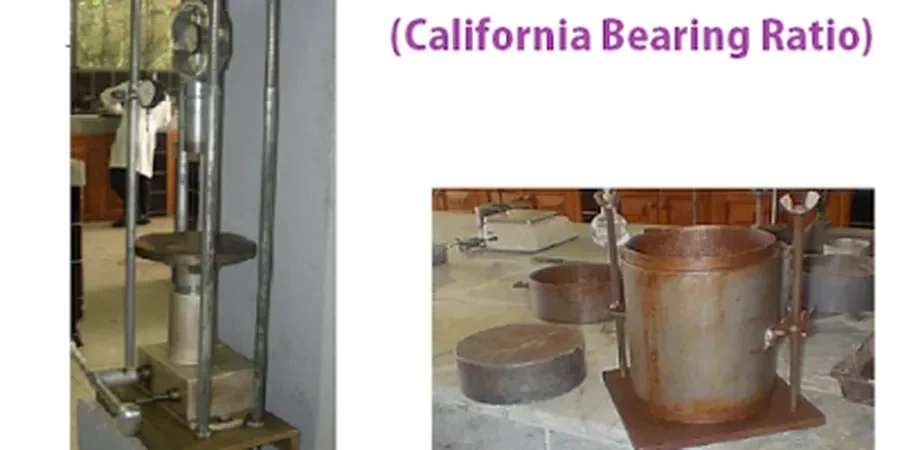
A hydraulic loading frame applying 1.27 mm per minute through a calibrated 50 kN load cell sits inside our Kelowna lab, preparing for the next batch of CBR specimens. The pistons compress remolded samples submerged in water for 96 hours, simulating the worst-case saturation conditions that Okanagan silts experience during spring freshet. Kelowna's lacustrine deposits, remnants of glacial Lake Penticton, exhibit California Bearing Ratios ranging from 3 to 8% in native state, which forces pavement engineers to specify thicker granular base courses than the default Ministry of Transportation BC schedules. We run the penetration test on both unsoaked and soaked specimens to quantify the strength loss ratio, a parameter that directly dictates the structural number required for flexible pavement design in subdivisions around Upper Mission and Black Mountain. When the soaked CBR drops below 2%, we often recommend combining results with a Proctor test to verify compaction targets before importing select fill.
A soaked CBR of 3% versus 8% can mean the difference between 150 mm and 300 mm of granular base course in Kelowna's frost-susceptible silts.
Regional considerations
The subgrade beneath Rutland's post-glacial silts rarely resembles the material under Dilworth Mountain's weathered till, yet both neighborhoods sit within five kilometers of each other. Rutland soils, derived from lacustrine settling in the post-glacial Lake Penticton basin, produce soaked CBR values as low as 2%, requiring full-depth asphalt or cement-stabilized subgrade to prevent rutting under the 80 kN equivalent single axle loads common on Highway 33. The Dilworth benchlands, by contrast, sit on compact basal till with CBR values exceeding 15%, permitting reduced pavement structures that save $18 to $25 per square meter in aggregate costs. Skipping the laboratory CBR test across a project that spans both soil regimes leads to under-designed sections that fail within two freeze-thaw cycles, when the saturated silts lose bearing capacity and the asphalt tensile strain at the bottom of the bound layer exceeds the 70 microstrain threshold for fatigue cracking. The City of Kelowna's design guidelines now mandate CBR values for any arterial road reconstruction, a direct response to the 2019 Rutland Road rehabilitation where post-construction testing revealed a 60% over-design in the Dilworth section.
Common questions
What does a laboratory CBR test cost in Kelowna?
A single-point laboratory CBR test on a remolded specimen runs between CA$170 and CA$290, depending on whether you need the unsoaked value only or the full soaked series with swell measurement and multiple compaction points. Most pavement design briefs require three points to establish the moisture-density-strength relationship, so budget CA$510 to CA$870 for a complete subgrade characterization.
How long does the lab CBR test take from sample delivery to report?
The soaking phase alone takes 96 hours per ASTM D1883, and compaction plus penetration testing adds another day. Standard turnaround in our Kelowna lab is 7 to 10 business days. Expedited processing is available when the compaction effort and penetration testing are queued immediately after sample receipt, but the four-day soak is non-negotiable for soaked CBR values.
Which CBR value does the City of Kelowna require for residential streets?
The City of Kelowna generally requires a minimum soaked CBR of 5% for local residential streets under standard traffic loading, but subdivisions on the silty soils of the Mission Creek floodplain often need cement stabilization to achieve this. Arterial roads follow the BC Ministry of Transportation pavement design tables, which demand CBR inputs for each subgrade layer. We recommend confirming the specific design CBR with your geotechnical engineer before sampling.
Can I use field CBR data instead of laboratory CBR for Kelowna pavement design?
Field CBR tests, such as those using a dynamic cone penetrometer correlated to CBR, provide useful screening data, but the City of Kelowna and BC MoTI require laboratory CBR values for final pavement thickness design. The lab test controls moisture content to the worst-case soaked condition, which the field test cannot replicate. We typically use field DCP data to select sampling depths, then confirm with laboratory CBR on remolded specimens.