← Home · Investigation

Cone Penetration Testing in Kelowna — CPT Data for Okanagan Soils

Together, we solve the challenges of tomorrow.

DETAILS →

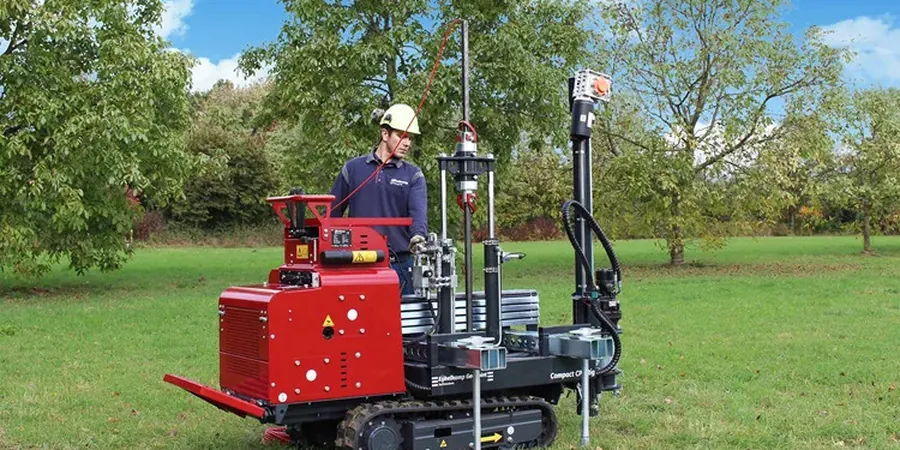
A common mistake in Kelowna is relying on sparse borehole logs alone when designing on the city's complex glacial lake deposits. A single SPT value every five feet misses thin silt seams and loose lenses that drastically alter bearing capacity. The CPT cone penetration test eliminates this guesswork. We collect continuous tip resistance, sleeve friction, and pore pressure data every centimeter. This profile reveals exactly where soft zones exist before you pour concrete. For deeper sites near the Mission Creek fan, combining CPT with an SPT drilling campaign validates the correlation for local soil behavior units. Our rig operates from a compact truck platform, accessing tight lots along Lakeshore Road without disturbing mature landscaping.

Continuous CPT data removes the blind spots between samples. You see the thin silt layer at 4.2 meters that a split-spoon missed.
Method and coverage

Kelowna's semi-arid climate creates a unique upper crust in the soil column. Long dry summers desiccate the top three meters of silt, producing stiff overconsolidated crust. Below that, you often find normally consolidated silty clay with high sensitivity. A standard test pit cannot penetrate this crust reliably. The CPT pushes a 15 cm² cone through both zones in one continuous stroke. We record the exact depth where the crust transitions to soft sediment. This boundary is critical for liquefaction analysis under the NBCC seismic provisions. For sites within the Glenmore valley, pore pressure dissipation tests during CPT stops measure the coefficient of consolidation directly, accelerating the settlement timeline for mat foundations.
Cone Penetration Testing in Kelowna — CPT Data for Okanagan Soils
Technical reference image — Kelowna

Regional considerations

The CPT truck sets up with a leveling system and twin hydraulic rams anchored against the vehicle weight. In Kelowna's softer silt zones near Okanagan Lake, the push force rarely exceeds 80 kN. But in the upper Mission area, dense gravel lenses can catch the cone tip and spike the resistance instantly. Our operator monitors the real-time graph on a rugged tablet inside the cab. A sudden jump in qt combined with low friction ratio triggers an immediate stop. We extract and offset the push point by 30 cm to bypass the obstruction. This protects the cone electronics and the rod string. Without experienced judgment, a gravel refusal can bend a rod and lose a day of production.

Need a geotechnical assessment?

Reply within 24h.

Email: contact@geotechnicalengineering.xyz

Process video


Technical parameters

ParameterTypical value
Cone capacity100 kN (standard); 200 kN for deep push
Pore pressure transducerU2 position, 5 MPa range
Data interval10 mm continuous sampling
Max penetration depth30 m in typical Okanagan silts
Sleeve friction accuracy±0.1 kPa
Standard referenceASTM D5778-20
Inclinometer±15° tilt monitoring
Dissipation testt50 recorded per ASTM protocol

Complementary services


01

Seismic Site Classification

Vs30 estimation from CPT correlations using Robertson method. Generates NBCC Site Class A through E assignments for Kelowna structural design.

02

Liquefaction Triggering Analysis

Boulanger and Idriss CPT-based procedure for the Okanagan seismicity. Produces factor of safety and LPI plots for foundation reports.

03

Shallow Foundation Settlement

Schmertmann method applied directly to CPT qt profiles. Delivers immediate settlement curves without waiting for lab consolidation tests.

Standards that apply

ASTM D5778-20, NBCC 2020 Division B Part 4, CSA A23.3 Annex A

Common questions


What depth can a CPT reach in Kelowna’s glacial silts?

Our 20-ton truck typically pushes to 25 meters in the valley bottom silts before rod friction limits progress. In denser till at higher elevations, refusal often occurs between 15 and 20 meters when tip resistance exceeds 50 MPa consistently.

How much does a CPT sounding cost for a Kelowna lot?

A single CPT sounding to 20 meters depth ranges from CA$220 to CA$330 depending on site access and whether dissipation tests are required. Multiple soundings on the same day reduce the per-hole rate.

Can CPT replace boreholes completely for a house foundation?

For typical single-family homes in Kelowna, one CPT plus one sampled borehole provides an optimal dataset. The CPT gives the continuous profile, while the borehole recovers actual soil samples for visual classification and Atterberg limits at key depths.

Location and service area

We serve projects across Kelowna and its metropolitan area.

View larger map