← Home · Slopes & Walls

Retaining Wall Design in Kelowna: Geotechnical Input That Holds the Slope

Together, we solve the challenges of tomorrow.

DETAILS →

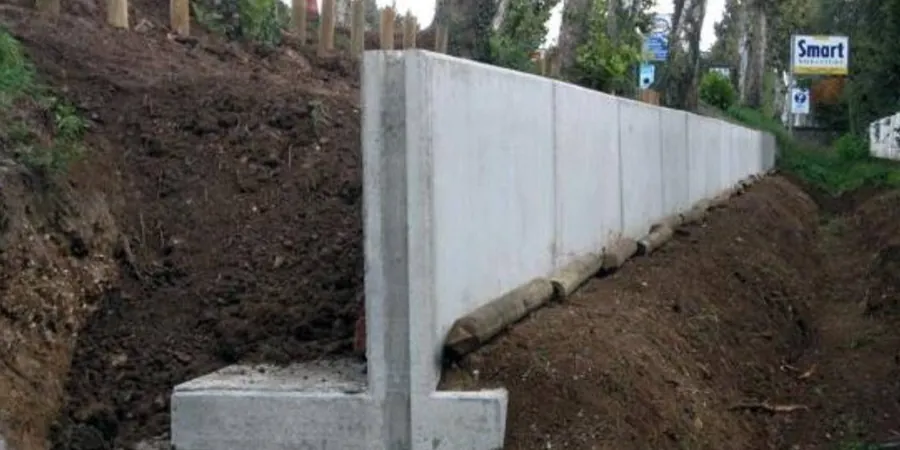
A retaining wall design in Kelowna that skips the site-specific shear strength data is a wall waiting to tilt. We see it too often: a contractor pulls standard bearing values from a report done 5 km away, then the first spring thaw saturates the backfill and the whole thing starts creeping. It is not that the wall was built badly; it is that the silt and clay deposits left by the Okanagan glacial lakes behave very differently from the gravels up on the benches. Our lab runs direct shear and triaxial tests on undisturbed Shelby tube samples taken from the exact wall alignment so the engineer has friction angles and cohesion numbers that actually represent the ground at 49.8879, -119.4959. For taller walls or those near lot lines, we often recommend pairing the lab program with a slope stability analysis to check global failure surfaces that a simple wall design might miss.

Kelowna walls fail most often not from weak reinforcement but from drainage that ignores the real grain-size curve of the retained soil.

Method and coverage

The Okanagan Valley climate throws a curveball at retaining wall design that many generic guides overlook. Kelowna cycles through bone-dry summers where clay shrinks away from the back of the wall, then winter brings freeze-thaw cycles that generate lateral pressures well beyond the at-rest condition. We have measured pore pressure build-up behind walls in the Lower Mission area that doubled the assumed hydrostatic load simply because the drainage blanket was designed with a generic perm rating instead of matching it to the actual grain-size curve of the local silty sand. Our approach ties the wall design parameters directly to the material we log on site: we run grain-size distributions on the retained soil, Atterberg limits to flag expansive potential, and consolidated-drained triaxial tests when the wall will sit in a zone where the water table rises within the failure wedge during freshet. Those numbers feed straight into the earth pressure coefficients the structural engineer needs for stem and heel design under NBCC 2020 and CSA A23.3, and we document everything under our ISO/IEC 17025 scope so the city reviews move faster.
Retaining Wall Design in Kelowna: Geotechnical Input That Holds the Slope
Technical reference image — Kelowna

Regional considerations

The valley bottom around downtown Kelowna and the Pandosy corridor sits on glaciolacustrine silts that are prone to liquefaction under the seismic loads defined in NBCC 2020 for the Okanagan. A retaining wall founded on these materials without a site-specific seismic lateral earth pressure check is a liability that gets exposed during the next moderate event. We have cored through these deposits and found layers of varved clay that lose half their undrained shear strength when remolded by cyclic loading. The worst scenario we see in practice is a wall with a steep backslope and a pool in the backyard above it: the combination of saturated ground, a seismic increment of lateral thrust, and no free-draining zone behind the wall creates a condition where the factor of safety on overturning drops below 1.0 fast. Our lab quantifies that risk by running cyclic triaxial tests on the foundation silt and providing the residual strength parameters the wall designer needs to check post-liquefaction stability.

Need a geotechnical assessment?

Reply within 24h.

Email: contact@geotechnicalengineering.xyz

Process video


Technical parameters

ParameterTypical value
Effective friction angle (CD triaxial)28° to 36° typical for Okanagan silts
Drained cohesion intercept0 to 15 kPa depending on clay fraction
Soil unit weight (moist)17.5 to 20.5 kN/m³
Saturated unit weight19.0 to 22.0 kN/m³
Hydraulic conductivity (backfill)1×10⁻⁷ to 1×10⁻⁴ m/s
Lateral earth pressure coefficient (Ka)Computed per Coulomb/Rankine
Bearing capacity for wall footingVerified by SPT drilling at base elevation
Freeze-thaw susceptibilityClassified per ASTM D5918

Complementary services


01

Shear strength testing for wall design

Direct shear and triaxial tests on undisturbed samples to define drained friction angle and cohesion for active, at-rest, and passive earth pressure calculations per Rankine or Coulomb theory.

02

Backfill drainage characterization

Grain-size distribution and permeability tests on the proposed backfill material to design graded filter zones that prevent clogging and pore pressure build-up behind the wall.

03

Foundation bearing verification

Unconfined compression and pocket penetrometer screening of footing subgrade, supplemented by SPT correlations, to confirm the allowable bearing pressure assumed in the wall design.

Standards that apply

NBCC 2020 (seismic hazard, structural loads), CSA A23.3-19 (concrete design for walls), ASTM D4767-11 (consolidated-drained triaxial), ASTM D3080-11 (direct shear), CSA + ASTM D422 (grain-size analysis)

Common questions


What soil parameters do I need from the lab to design a retaining wall in Kelowna?

At minimum, you need the effective friction angle and cohesion of the retained soil and the foundation soil, plus the moist and saturated unit weights. If the wall is over 1.5 m or supports a surcharge, we recommend consolidated-drained triaxial tests rather than direct shear, because they give you the stress-strain curve needed for serviceability checks. We also run grain-size analysis on the backfill to size the drainage aggregate correctly for the local silty material.

How does the Okanagan climate affect retaining wall design?

Kelowna sees big swings: dry summers can shrink clay behind the wall, creating gaps that fill with water in the fall rain. Winter freeze-thaw cycles add lateral pressure that can exceed the at-rest condition if the drainage is undersized. We account for this by testing the retained soil's frost susceptibility per ASTM D5918 and recommending a drainage blanket thickness based on the actual permeability of the backfill, not a generic catalog value.

Do I need a slope stability assessment together with the wall design?

If the wall is over 2 m tall or sits mid-slope on one of the benches above the lake, yes. The wall itself may be stable, but the global failure surface passing under the toe can still move. Our lab provides the shear strength profile for a slope stability model, and we flag zones where the glaciolacustrine silt shows strain-softening behavior that a simple limit-equilibrium analysis could miss.

What is the typical cost range for retaining wall geotechnical testing in Kelowna?

For a typical residential or light commercial retaining wall project in Kelowna, the geotechnical lab testing package generally runs between CA$1,360 and CA$6,440, depending on the number of boreholes, sample depth, and whether triaxial or direct shear testing is required. A taller wall with a full drained triaxial suite on multiple samples will be at the upper end of that range.

Can you test the backfill after compaction to confirm the wall design assumptions?

Absolutely. We run Proctor compaction tests on the proposed backfill to set the target density, then field density verification with a nuclear gauge or sand cone. We also re-run a grain-size analysis on the compacted material to confirm the drainage properties still match the graded filter design specified for the wall.
Location and service area

We serve projects across Kelowna and its metropolitan area.

View larger map