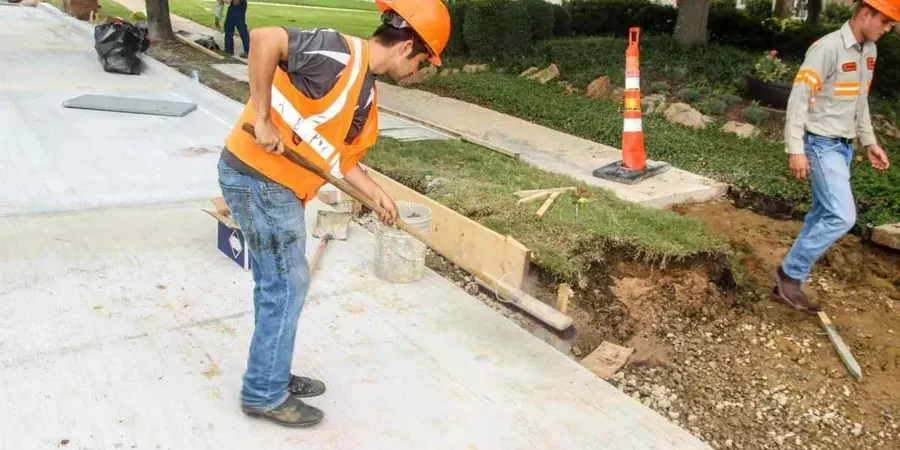
When the slipform paver rolls onto a Kelowna job site, the concrete mix better be dialed in for what's underneath. You can't just pour a standard Caltrans slab over Okanagan silty clay and call it a day. Our team looks at the entire section: subgrade stiffness, drainage, freeze-thaw cycles, and the actual aggregate gradation coming out of local quarries near Postill Lake Road. Rigid pavement design means deciding joint spacing, dowel bar diameter, and slab thickness all at once, because once that concrete sets, fixing a curling slab costs more than the original pour. We often bring in a CBR road test during the subgrade phase to confirm the bearing capacity before the first batch plant even fires up. In Kelowna, where winter temperatures dip below -15°C some years, air-entrainment and proper curing are non-negotiable. A well-designed rigid pavement here should see 25-plus years of service with minimal joint spalling if the base preparation is done right.
A rigid pavement slab is only as good as the joint that contains its movement: get the spacing wrong in Kelowna's climate and you'll chase cracks for a decade.
Regional considerations
The most common mistake we see in Kelowna is treating the granular subbase as an afterthought. A contractor will scrape to grade, drop 100 mm of crushed gravel, compact it with a single pass, and then start setting forms. Two winters later, the slab panels are rocking under forklift traffic because the fines in the subbase migrated into the silty subgrade, creating voids. A rigid pavement design that doesn't specify a separation geotextile where the native soil has more than 15% silt is gambling with the client's money. Another frequent error is ignoring the thermal gradient through the slab thickness. In the Okanagan, a 40-degree surface temperature swing between a July afternoon and the same night can induce enough curling stress to crack an unreinforced slab if the joint spacing was copied from a Vancouver spec. We always run a finite element check on the critical edge stress condition before issuing sealed drawings.
Common questions
How thick does a concrete pavement need to be for a truck yard in Kelowna?
For heavy truck traffic, we typically design unreinforced slabs between 200 and 260 mm thick depending on the subgrade k-value and the expected ESAL loading. A yard serving B-trains daily might go to 280 mm. The thickness comes from the PCA and AASHTO 93 methods using specific local inputs: subgrade strength, concrete flexural strength, and 20-year traffic projections. We never guess at this—one under-designed slab that fails in two years costs far more than getting the thickness right from the start.
Does the Kelowna climate affect rigid pavement joint spacing?
Absolutely. Kelowna sees summer highs above 35°C and winter lows below -15°C, so the concrete slab experiences a wide thermal range. We design joint spacing conservatively—usually 3.5 to 4.5 meters for a 200 mm slab—to keep curling stresses manageable. Wider spacing works in coastal BC but will cause mid-panel cracking here. The joint sealant selection also matters: we specify silicone or preformed compression seals that stay flexible in Okanagan winters.
What does rigid pavement design cost for a project in Kelowna?
A stamped rigid pavement design package for a typical commercial or industrial project in Kelowna falls in the range of CA$2,910 to CA$8,310, depending on the pavement area, number of joint details required, and the complexity of the subgrade investigation. A small parking lot with straightforward geotechnical conditions sits at the lower end, while a large distribution center with variable soils and multiple tie-in details moves toward the upper end.
Can you design a concrete pavement over poor soil without removing it all?
Yes, in many cases. We evaluate the in-situ subgrade with field testing and then design a stabilized subbase or a thicker slab section to bridge weaker soils. In some Kelowna locations with deep silt deposits, we may recommend stone columns to improve the bearing capacity before placing the granular base. The key is knowing the actual soil properties—we never write a pavement spec without seeing the subgrade test results first.