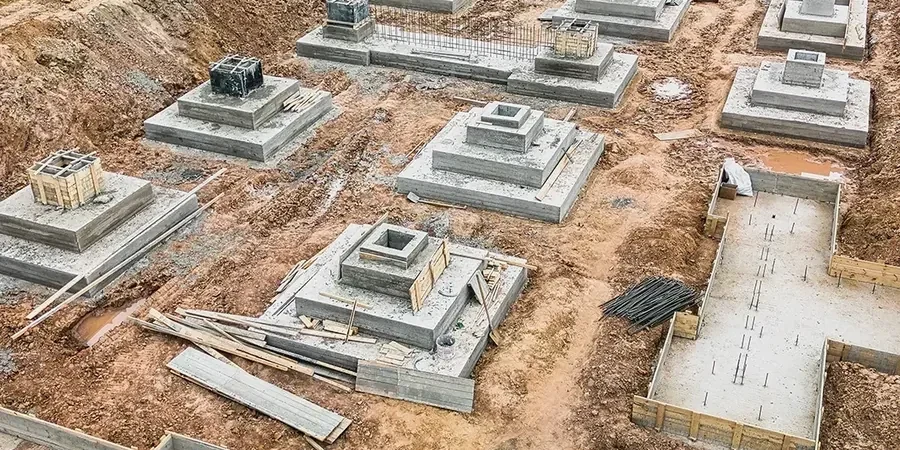
Kelowna's rapid expansion from a quiet orchard town to the Okanagan's largest city has pushed construction onto terrain that demands serious foundation engineering. The post-glacial landscape here tells a story of deposition and erosion — thick sequences of silts, clays, and sands left by Glacial Lake Penticton blanket the valley floor, while steep benchlands rise sharply on both sides of Okanagan Lake. Building on these deposits requires more than standard footings. The lake silts can compress under load, the water table sits high near the shoreline, and the Mission Creek fan has deposited loose granular soils across a broad swath of the lower city. For structures exceeding three storeys — or any project near the lakefront — pile foundation design becomes the logical path to transfer structural loads down to competent bearing strata. Our geotechnical team has logged hundreds of boreholes across Kelowna, from the Pandosy corridor to the Upper Mission, and we understand how the subsurface here behaves under load. For projects in the valley bottom, we often combine CPT testing data with laboratory strength parameters to refine pile capacity predictions before a single rig mobilizes to site.
A pile is only as reliable as the soil data beneath its toe. In Kelowna's variable glacial deposits, one borehole per building corner is the minimum — not the standard.
Regional considerations
The most expensive mistake we see in Kelowna is specifying driven piles without first confirming the depth to refusal. Glacial till here can be erratic — dense, cobble-rich layers appear at variable depths, sometimes 12 meters down, sometimes 25. A contractor assumes a 20-meter pile length, orders steel, mobilizes a hammer, and then hits refusal at 14 meters. Now you have piles too short for the design load and a crew standing idle while the engineer re-runs the numbers. That delay costs more than the geotechnical investigation ever would have. Worse still is the scenario where loose silts go undetected beneath a proposed pile toe. The pile drives to target depth, load tests are scheduled, and the settlement under test load exceeds the NBCC serviceability limit. Retrofit options are limited — you are looking at either deeper piles or a revised foundation concept. Neither is cheap. A proper site investigation with SPT drilling at each pile location, combined with laboratory consolidation testing on undisturbed Shelby tube samples, eliminates these surprises before they become change orders.
Common questions
What depth do piles typically need to reach in Kelowna?
In the valley bottom near the lake, bearing strata — dense glacial till or bedrock — is typically encountered between 18 and 30 meters depth. Sites on the benches may reach competent material at shallower depths, sometimes 10 to 15 meters, but the overburden can contain cobble-rich layers that complicate driving. We determine exact depths through site-specific borehole investigation and CPT soundings before finalizing the pile design.
How much does pile foundation design cost for a typical Kelowna project?
Pile foundation design services for a standard residential or light commercial project in Kelowna typically range from CA$2,200 to CA$7,910 depending on the number of piles, the complexity of the soil profile, and the required load testing scope. Larger multi-storey or lakefront developments fall toward the upper end due to additional analysis for lateral loads and liquefaction.
Do I need a pile foundation if my site is on flat ground in Kelowna?
Flat ground does not guarantee good soil. Much of Kelowna's flat valley floor sits on compressible glaciolacustrine silts deposited by Glacial Lake Penticton. These silts can settle significantly under structural loads. A geotechnical investigation determines whether shallow footings are viable or whether piles are needed to bypass the compressible layer and bear on deeper, competent material.
What is the difference between driven piles and cast-in-place piles for Kelowna sites?
Driven piles — steel H-piles or pipe piles — are hammered into the ground using a pile driver. They are fast, cost-effective for larger projects, and work well in the granular and till soils common in Kelowna. Cast-in-place piles are drilled shafts filled with concrete on site; they suit constrained urban sites where vibration and noise from driving would be problematic, and they allow inspection of the bearing surface before concrete placement.
Are pile load tests mandatory for Kelowna building permits?
The City of Kelowna requires verification of pile capacity for most deep foundation designs as part of the building permit submission. A static load test or high-strain dynamic test (with CAPWAP signal matching) is the standard method to confirm that installed piles meet the design capacity. We manage the testing program, interpret the data, and provide the signed documentation required by the municipality.