← Home · Laboratory

Atterberg Limits Testing in Kelowna — Plasticity & Clay Behavior

Together, we solve the challenges of tomorrow.

DETAILS →

In Kelowna, we often see contractors caught off guard by a soil that looks stable when dry but turns to a messy, expansive paste after a week of irrigation or spring runoff. A simple grain-size test won't tell you that story, but the Atterberg limits will. Our lab runs liquid and plastic limit tests to quantify exactly how a fine-grained soil behaves with water — which is critical when you're placing footings in the Glenmore clay belt or compacting subgrade along the hillsides above Okanagan Lake. The results feed directly into footing design and slope stability analyses, where knowing the plasticity index can mean the difference between a routine foundation and an expensive over-excavation. With over 150,000 people calling Kelowna home and construction pushing into glacial lakebed deposits, understanding soil consistency isn't just academic; it's a daily requirement for every geotechnical report we sign.

In Kelowna's glacial lake sediments, a soil's plasticity index often reveals more about its construction behavior than two pages of boring logs.

Method and coverage

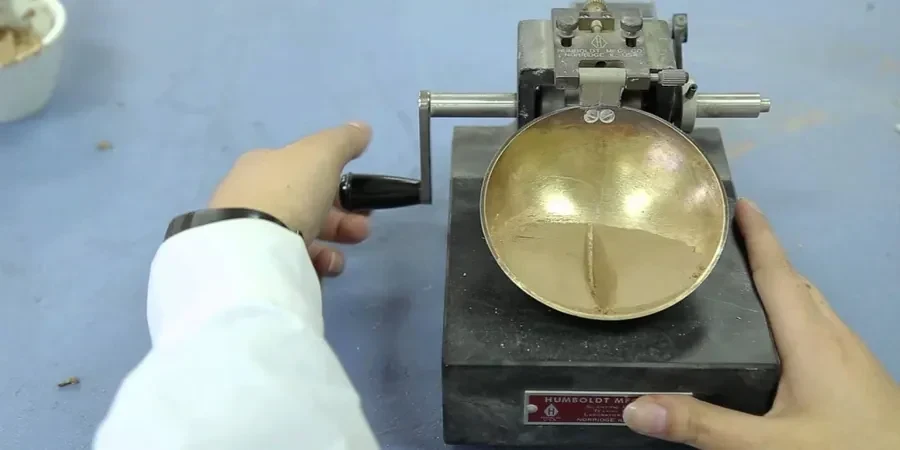
A recent project on the Westside involved a proposed retaining wall where the contractor assumed a stiff, brown silt would hold a near-vertical cut through the summer. We pulled a few Shelby tube samples from three meters down and ran the full set of consistency limits. The liquid limit came back at 58, the plastic limit at 22, giving a plasticity index of 36 — that's a high-plasticity silt, not a low-plasticity material. Once the fall rains hit, that cut would have started creeping. The data let the design engineer switch to a drained retaining wall system with granular backfill and proper weep holes, avoiding a costly rebuild. Our process follows ASTM D4318-17e1 precisely: we use the Casagrande cup method for the liquid limit and the standard 3.2 mm thread rolling procedure for the plastic limit. Every technician in the lab runs a daily moisture content check on their drying oven, and we participate in a round-robin proficiency program to keep our numbers tight — because when the Unified Soil Classification hinges on a single percentage point, calibration drift isn't an option.
Atterberg Limits Testing in Kelowna — Plasticity & Clay Behavior
Technical reference image — Kelowna

Regional considerations

Kelowna's urban growth since the 1980s has pushed subdivisions into the silty terraces and glaciolacustrine deposits that surround the city, and some of those soils are far more active than their grain size suggests. We've seen projects around the Mission and Crawford areas where a low-plasticity silt on paper turned out to contain enough smectite clay to produce a PI above 30 — that puts it in the range of moderate to high swell potential. Skipping the Atterberg limits on these sites leaves you blind to seasonal volume change, which in a climate that swings from -20°C to +35°C can open hairline cracks into full structural movement within two freeze-thaw cycles. When the limits are combined with a liquefaction assessment or a grain-size analysis, you get a complete picture of how the soil skeleton will behave under both static and seismic loading — something the NBCC expects engineers to demonstrate for any Category 2 or 3 building in the Okanagan.

Need a geotechnical assessment?

Reply within 24h.

Email: contact@geotechnicalengineering.xyz

Technical parameters


ParameterTypical value
Test StandardASTM D4318-17e1
Liquid Limit DeviceCasagrande cup (manual, hard rubber base)
Plastic Limit Method3.2 mm thread rolling by hand
Sample PreparationWet preparation, sieved through No. 40 (425 µm)
Plasticity Index (PI)LL - PL (reported to nearest whole number)
Liquidity IndexCalculated from natural water content
Typical Kelowna SiltsLL 35–65, PL 15–25, PI 15–40
Report Turnaround2–3 working days after sample receipt

Complementary services

01

Liquid & Plastic Limit Pair

The core test: we determine both the liquid limit and plastic limit on a single disturbed sample, reporting the plasticity index and the USCS classification symbol. This is the minimum we recommend for any fine-grained soil encountered in a test pit or borehole in Kelowna.

02

Full Consistency Suite

We add the natural water content and, from that, compute the liquidity index. This tells you how close the in-situ soil is to its liquid limit — a number that contractors find incredibly useful when deciding on trafficability and excavation support.

03

Multi-Depth Profile

For sites with layered silts and clays, we run limits at 0.5 m vertical intervals from continuous samples. The resulting plot of PI versus depth often reveals a weathered crust or a thin, high-plasticity seam that a single bulk sample would miss.

Standards that apply


ASTM D4318-17e1 — Standard Test Methods for Liquid Limit, Plastic Limit, and Plasticity Index of Soils, ASTM D2487-17e1 — Standard Practice for Classification of Soils for Engineering Purposes (Unified Soil Classification System), NBCC 2020 Division B, Section 4.2 — Seismic design requirements referencing site class determination

Common questions

What does a typical Atterberg limits test cost in Kelowna?

A standard pair (liquid limit plus plastic limit) generally runs between CA$90 and CA$150 per sample, depending on whether it's a standalone request or part of a larger testing package. Samples that need extended preparation, such as those with high organic content, may fall at the upper end of that range.

How long does the lab need to deliver results?

Most samples are turned around in two to three working days. The oven-drying step alone takes 16 to 24 hours to meet ASTM D4318 requirements, and we run a second moisture content verification on any sample where the plastic limit thread test gives borderline results.

Can you run the test on samples I've already collected?

Yes, as long as the sample is sealed to prevent moisture loss and hasn't been air-dried. We prefer a minimum of 150 grams of material passing the No. 40 sieve. If the sample has dried out, the Atterberg limits can shift permanently, so we'd recommend a fresh Shelby tube or bulk bag for reliable numbers.
Location and service area

We serve projects across Kelowna and its metropolitan area.

View larger map