← Home · Improvement

Vibrocompaction Design in Kelowna — Deep Compaction for Glacial-Lacustrine Soils

Together, we solve the challenges of tomorrow.

DETAILS →

The Okanagan Valley floor beneath Kelowna presents a classic post-glacial challenge: meters of loose, water-laid silts and fine sands deposited by ancient Lake Penticton. These soils, often found at 5 to 15 meters depth across the city's expanding industrial parks and lakeshore developments, can densify abruptly under earthquake loading or sustained structural demand. Standard shallow compaction in Kelowna rarely reaches deep enough to address the problem—this is where vibrocompaction design becomes essential. By specifying vibrator type, grid spacing, and energy input based on site-specific CPT data, we convert loose deposits into a competent bearing stratum without excavation and replacement. The approach saves weeks on the construction schedule and avoids importing thousands of cubic meters of engineered fill, a logistical headache in Kelowna's constrained valley corridors. For sites with interbedded clay lenses, we often combine vibrocompaction with stone columns to provide drainage paths that accelerate consolidation and reduce post-construction settlement.

Vibrocompaction in Kelowna transforms 10 meters of loose lake silt into a dense bearing layer in under a week—no excavation, no imported fill.

Method and coverage

Design under the National Building Code of Canada (NBCC 2020) and CSA A23.3 requires that Improvement for seismic site class upgrade be validated with pre- and post-treatment penetration testing. In Kelowna, where a Site Class D or E soil profile can amplify spectral acceleration by 30–40% over bedrock, vibrocompaction design aims to shift the site to Class C where feasible. Our process starts with a target relative density—typically 70–75% for low-rise commercial and 80–85% for mid-rise structures—derived from liquefaction triggering analysis per Youd & Idriss (2001) procedures. We then select vibrator power (130–180 kW units for depths to 18 m), probe spacing on a triangular grid (2.0–3.5 m), and compaction time per stage. Water jetting is kept minimal to avoid destabilizing nearby slopes above Okanagan Lake. Quality control relies on CPT testing before and after treatment; we compare cone resistance profiles to confirm the design target has been met across the full treatment depth, not just near the surface. A final MASW survey provides a post-improvement Vs profile for the seismic report submitted to the City of Kelowna.
Vibrocompaction Design in Kelowna — Deep Compaction for Glacial-Lacustrine Soils
Technical reference image — Kelowna

Regional considerations

Kelowna’s development history is a story of orchards turned into subdivisions and now high-density lakefront towers, often built on the same unconsolidated valley-bottom sediments that were never designed for modern structural loads. The 2013 seismic hazard model for the Okanagan region raised the design spectral acceleration values for Kelowna above 0.35g for a 1-in-2475-year event, which puts loose saturated sands squarely in the crosshairs for liquefaction and flow-slide risk. Skipping deep ground treatment on a site with a pre-improvement qc below 5 MPa invites differential settlement that can rack a building frame and rupture utility connections. Vibrocompaction design forces the engineer to confront the real vertical extent of the problem—not just assume the upper 3 meters are enough. In the Rutland and north-end industrial zones, where fill placement in the 1970s left undocumented loose pockets, we have measured post-treatment settlement reductions of 80–90% within the first meter of the improved column.

Need a geotechnical assessment?

Reply within 24h.

Email: contact@geotechnicalengineering.xyz

Technical parameters


ParameterTypical value
Applicable soil typesClean sands to silty sands with fines <15%; gravels <50 mm
Typical treatment depth in Kelowna6 to 18 meters below grade
Target relative density (Dr)70–85% depending on structural loading and seismic demand
Vibrator power range130–180 kW electric or hydraulic, 30–50 Hz frequency
Grid patternTriangular spacing 2.0–3.5 m, adjusted per CPT calibration zone
Post-treatment verificationCPT cone resistance increase ≥2× baseline; Vs30 ≥200 m/s for Site Class C
Settlement reduction targetPost-compaction settlement <15 mm under design bearing pressure
Reference standardASTM D6066-11, NBCC 2020, CSA A23.3 Annex M

Complementary services

01

Pre-Treatment Site Characterization

We execute CPT soundings on a grid matching the proposed vibrator spacing, supplemented by select SPT borings to recover samples for fines content and grain-size distribution. This phase identifies the liquefiable zone bottom, groundwater level, and any interbedded clay seams that would limit vibrator effectiveness.

02

Vibrocompaction Design Package

The deliverable includes vibrator selection, compaction grid layout with stage sequence, energy criteria per probe, and a seismic settlement analysis comparing pre- and post-treatment conditions. The package is stamped by a professional engineer registered in British Columbia and formatted for City of Kelowna building permit submission.

03

Post-Treatment Verification and As-Built Report

After compaction, we perform CPT soundings at offset positions from the original grid to measure cone resistance improvement. A final Vs30 profile via MASW, combined with updated liquefaction triggering curves, confirms the achieved Site Class. The as-built report includes treatment logs, refusal depths, and a signed statement of compliance with NBCC design parameters.

Standards that apply


ASTM D6066-11: Standard Practice for Determining the Normalized Penetration Resistance of Sands for Evaluation of Liquefaction Potential, NBCC 2020, Division B, Part 4: Structural Design — Seismic Provisions and Site Classification, CSA A23.3: Design of Concrete Structures — Annex M: Geotechnical Seismic Site Response, Youd, T.L. & Idriss, I.M. (2001) — Liquefaction Resistance of Soils: NCEER/NSF Workshop Recommendations

Common questions

How deep can vibrocompaction reach in the silty soils common around Kelowna?

In the fine sands and low-plasticity silts typical of the Okanagan Valley floor, we routinely achieve treatment to 18 meters with a 180 kW electric vibrator. The practical limit is controlled by fines content: once the passing-200-sieve fraction exceeds 15–18%, pore pressure dissipation slows and effectiveness drops. Our pre-treatment CPT program identifies this boundary so we can set a realistic target depth for each zone.

What does vibrocompaction design cost for a typical commercial lot in Kelowna?

For a standard commercial footprint in Kelowna requiring treatment to 10–12 meters depth, the engineering design package—including pre-treatment CPT, vibrator grid specification, and post-treatment verification—typically falls between CA$2,180 and CA$8,010. The range depends on the number of compaction points, depth, and whether a MASW survey is required for the seismic report. We provide a fixed-fee quote after reviewing the geotechnical baseline report.

Is vibrocompaction feasible next to existing buildings in downtown Kelowna?

It depends on the offset distance and the condition of the adjacent structures. Vibratory energy attenuates quickly in soil, but within 5 to 8 meters of a sensitive heritage masonry building, we would typically switch to stone columns or low-headroom compaction grouting instead. We run a vibration monitoring plan with triaxial geophones on the nearest foundation wall whenever the standoff is under 15 meters, and we adjust hammer energy to stay below a peak particle velocity of 5 mm/s.

How long does the compaction process take on site?

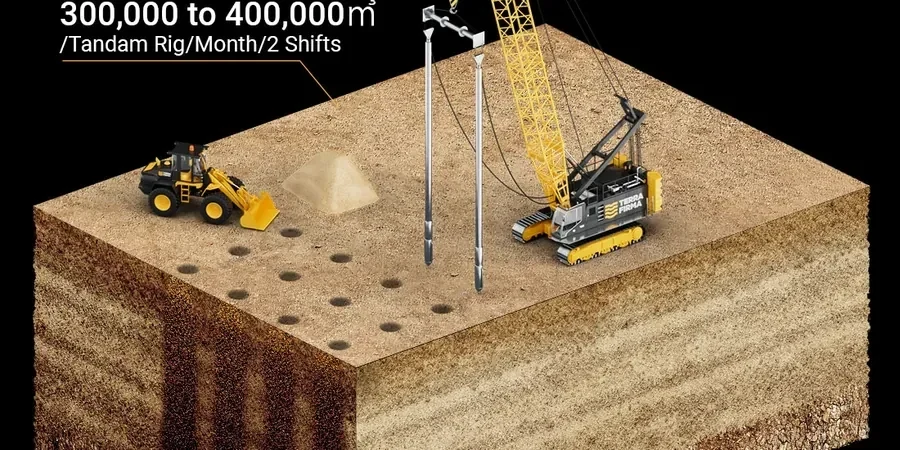
A single vibrocompaction rig with a three-person crew can treat 20 to 35 probe locations per shift, depending on depth and soil resistance. For a 1,000-square-meter footprint on a typical Kelowna industrial lot, the field work is usually completed in four to six working days. The pre- and post-treatment CPT testing adds another two to three days, so the full Improvement campaign—from mobilization to verification—fits within two weeks.
Location and service area

We serve projects across Kelowna and its metropolitan area.

View larger map