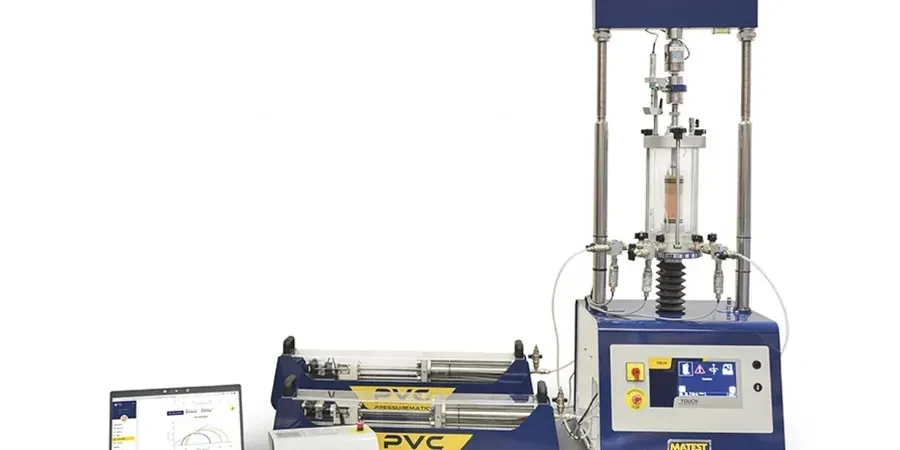
A 15-story mixed-use project on Ellis Street hit bedrock at 12 meters. The glacial till layer above it had the developer worried. Standard SPT blows were decent, but the structural engineer needed more than N-values. They needed the soil's real shear strength. That's where the triaxial test comes in. We ran a consolidated-undrained series with pore pressure measurement. The friction angle came back at 34 degrees with cohesion of 12 kPa. Higher than the empirical correlations suggested. The foundation design got optimized by 18 percent. In Kelowna, where lacustrine silts and glacial deposits dominate the valley floor, a grain-size analysis alone won't tell you how the soil behaves under load. The triaxial test gives you the numbers that matter for bearing capacity calculations and slope stability models.
Effective friction angles in Kelowna's glacial lake silts typically range 30-36 degrees when tested properly. Textbook values underestimate local soils by 15-20 percent.
Common questions
How many specimens do you need for one triaxial test series?
Three specimens are required for a standard CU or CD series to define the Mohr-Coulomb failure envelope at three different confining pressures. For a UU quick test, three specimens are also standard.
What type of triaxial test is right for a foundation on Kelowna's glacial lake silts?
Consolidated Undrained (CU) with pore pressure measurement per ASTM D4767. The valley bottom silts are saturated and generate excess pore pressure under load. CU gives both short-term total stress parameters and long-term effective stress parameters for the design engineer.
What is the typical turnaround time for triaxial testing in Kelowna?
A standard CU series takes 10-12 business days from specimen setup to final report. This includes saturation time, consolidation phases of 24-48 hours per specimen, and the controlled shear stage. CD tests run longer due to the slow shear rate required for drainage.
What does a triaxial test series cost for a typical Kelowna project?
A complete triaxial test series (CU with pore pressure, three specimens) ranges from CA$2,460 to CA$3,640 depending on specimen diameter, consolidation stress levels, and whether undisturbed Shelby tube samples or remolded specimens are used.