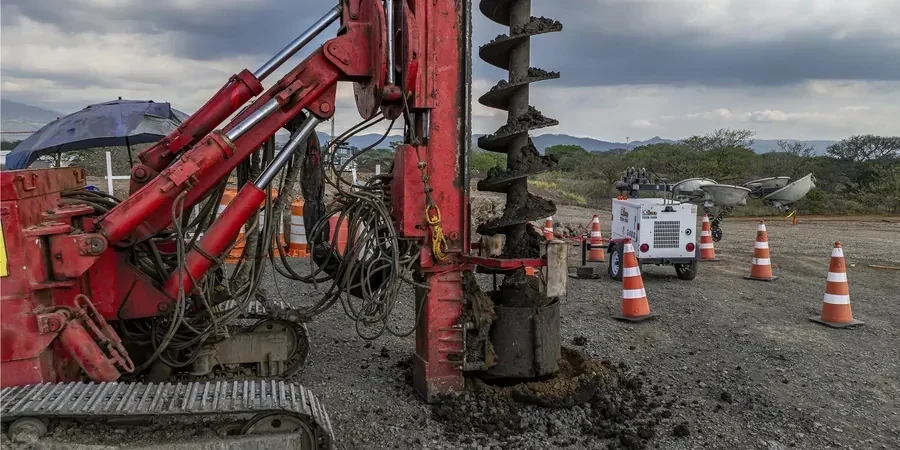
Kelowna's rapid expansion onto glaciolacustrine silts and Okanagan River alluvium demands foundation solutions that go beyond conventional footings. These fine-grained soils, particularly prevalent along the lakeshore and Mission Creek fan, are susceptible to settlement and liquefaction. A stone column design that accounts for the valley's stratigraphy—often soft clay over dense glacial till at depth—delivers a reliable, cost-effective alternative to deep piles. Our team has applied vibro-replacement methods across the Central Okanagan, from West Kelowna wineries to lakeshore condominiums, and we understand how seasonal groundwater fluctuations near Okanagan Lake influence installation parameters and long-term column performance. For projects where granular fill is scarce, we integrate material-sourcing strategies with the vibrocompaction work to keep logistics efficient.
A well-designed stone column grid can increase the composite ground bearing pressure by a factor of two to four over untreated Kelowna silt.
Method and coverage
Kelowna sits at roughly 344 meters elevation within a semi-arid valley, yet its urban core overlies up to 30 meters of compressible post-glacial sediment. This contrast means a stone column design here must handle both dry-summer crust effects and spring freshet saturation. We specify aggregate gradation that meets ASTM D448 and CSA A23.1 requirements, typically 25–75 mm clean stone, to maximize radial drainage and stiffness. Our load-transfer analysis uses Priebe's method and finite element models calibrated with local CPTu data, ensuring the column-to-soil stress ratio reflects actual undrained shear strengths—often as low as 25 kPa in the near-surface clays. Installation monitoring via real-time ammeter readings and post-treatment plate load tests confirms that the design modulus is achieved. For liquefaction-prone zones, we size columns to limit excess pore pressure buildup, referencing Youd-Idriss (2001) and NCEER guidelines, with residual settlement targets kept under 25 mm for typical mid-rise structures.
Regional considerations
The downtown Kelowna area and Pandosy corridor grew largely before modern geotechnical codes were enforced, leaving many older low-rises on shallow footings over compressible silt. When a developer buys an adjacent lot and deep excavation begins, the untreated ground can undergo lateral deformation that damages neighboring structures. We have seen settlement cracks appear in brick facades within weeks of unmitigated construction. A stone column design acts as both a foundation improvement and a vibration-limiting measure—dry top-feed methods reduce the vibration footprint compared to standard vibroflotation, which matters on tight urban sites. Skipping a site-specific response analysis in Kelowna's seismic Zone 4 (NBCC 2020) is a gamble: the soft soils can amplify peak ground acceleration by 30–50%, and without properly spaced columns, the post-earthquake differential settlement becomes unrepairable.
Standards that apply
ASTM D448-08 (Standard Classification for Sizes of Aggregate for Road and Bridge Construction), ASTM D1586-18 (Standard Test Method for Standard Penetration Test), CSA A23.1:19 (Concrete Materials and Methods of Concrete Construction – aggregate reference), NBCC 2020 Part 4 (Seismic Design provisions, Site Class E amplification), NCEER-97-0008 (Youd & Idriss liquefaction evaluation)
Common questions
How much does a stone column design package cost for a typical Kelowna project?
For a medium-complexity site—say a 4-story mixed-use building on Okanagan silts—the design, construction drawings, and field verification typically range from CA$2,040 to CA$7,320, depending on the number of column locations and the required seismic analysis. A site-specific estimate comes after we review the geotechnical baseline report.
What ground conditions in Kelowna are suitable for stone columns?
Stone columns work best in cohesive soils with undrained shear strength between 15 and 50 kPa, which includes the glaciolacustrine silts and soft clays found across the Kelowna valley bottom. They are not recommended in clean sands or gravels where vibrocompaction alone suffices, nor in organic soils thicker than 0.5 meters unless a pre-treatment excavation is planned.
How do you confirm the stone columns meet the design specification?
We combine real-time installation records—ammeter logs, stone volume per lift—with post-treatment testing. A zone load test on a representative column group measures the composite modulus directly, and we often run parallel CPT soundings between columns to verify density improvement. For liquefaction-critical sites, crosshole shear-wave velocity measurements confirm the achieved Vs profile.