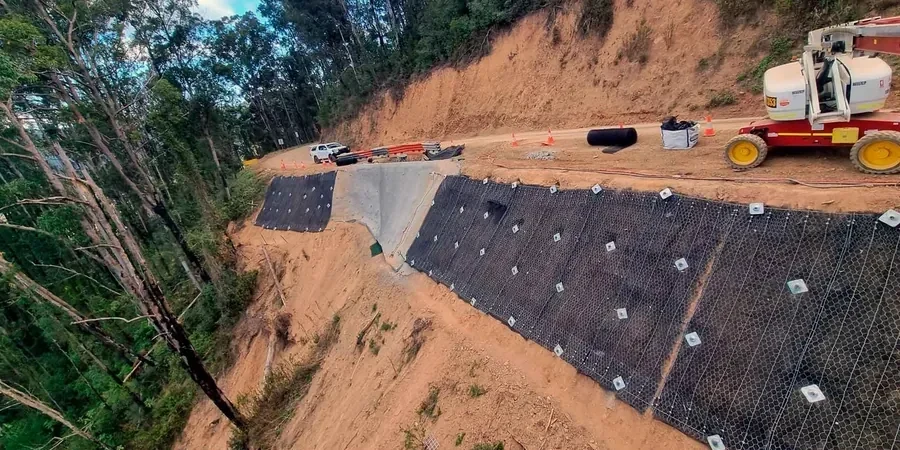
Kelowna’s topography demands rigorous geotechnical input before any excavation or foundation work begins. The city stretches along Okanagan Lake, flanked by benchlands and steep slopes carved by glacial retreat. Under the National Building Code of Canada, sites with gradients exceeding 15% require a site-specific slope stability analysis to assess failure risk and inform design. Our team evaluates Lake Terrace clay deposits, colluvial soils, and weathered bedrock interfaces that define much of the city's hillside geology. We calculate factor of safety values under static, seismic, and rapid-drawdown conditions, referencing FHWA-NHI-05 guidelines and local municipal requirements. For deeper stratigraphy control, we often pair the analysis with sondajes SPT to capture refusal depths and groundwater levels, especially in neighborhoods like Dilworth Mountain where soil profiles shift dramatically over short distances.
A slope with a factor of safety of 1.0 is not safe — it is at incipient failure. In Kelowna's Lake Terrace clays, we design for a minimum FoS of 1.5 under static conditions.
Regional considerations
A track-mounted CPT rig or a hollow-stem auger drill is what we mobilize onto Kelowna hillsides to get the data that feeds the stability model. Without direct push data and undisturbed samples, you are guessing at the depth of the shear plane. We have worked on sites along Lakeshore Road where a 3-meter vertical cut in saturated silt failed within hours of a heavy rain event — a textbook case of negative pore pressure loss. The analysis is only as good as the subsurface input. Slope angle, stratigraphy, and groundwater are the three legs of the stability stool; miss one, and the whole assessment collapses. In Kelowna, where winter freeze-thaw cycles and spring freshet raise groundwater tables sharply, seasonal monitoring data becomes essential for capturing the worst-case phreatic surface in the model.
Common questions
What slope stability analysis methods does your team use for Kelowna sites?
We apply limit equilibrium methods — Bishop, Spencer, and Morgenstern-Price — using software calibrated to Okanagan Valley soil units. For pseudo-static seismic analysis, we follow NBCC 2020 hazard values for Kelowna, which sits in a moderate seismicity zone. The analysis includes circular and non-circular slip surface searches, with sensitivity runs for varying groundwater conditions.
How much does a slope stability analysis cost in Kelowna?
Fees typically range from CA$1,860 to CA$5,330 depending on slope height, site access, and the number of cross-sections required. A single residential lot on a moderate incline falls toward the lower end, while a multi-section analysis for a subdivision or retaining wall design on a complex slope will be higher.
When is a slope stability analysis required for a building permit in Kelowna?
The City of Kelowna triggers the requirement when proposed construction lies within a mapped Hazard Lands Development Permit area, typically on slopes steeper than 15% or within the setback zone of a known landslide feature. The analysis must be stamped by a professional engineer registered in British Columbia.
What soil parameters do you input for Kelowna's Lake Terrace clays?
We derive drained and undrained shear strength from laboratory testing on undisturbed Shelby tube samples. For the glaciolacustrine clays common in the Mission and Southeast Kelowna, effective friction angles typically range from 24 to 30 degrees with cohesion intercepts of 5 to 15 kPa. Residual strength parameters are used for pre-existing shear surfaces.
Can you design the slope stabilization measures after the analysis?
Yes. Once failure mechanisms are identified, we prepare mitigation designs: buttress fills, ground anchors, soldier pile walls, or subsurface drainage systems. All designs comply with the BC Building Code and are prepared for City of Kelowna review.