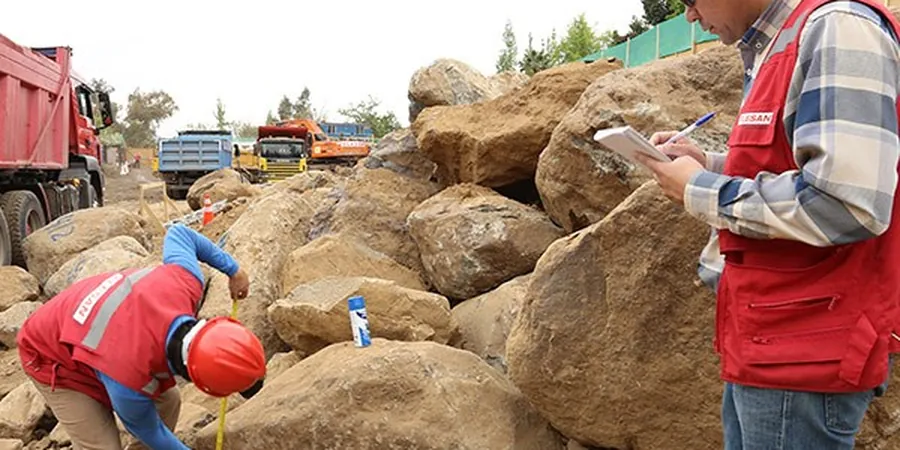
The Okanagan Valley didn't form by accident—Kelowna sits on a deep sequence of glaciolacustrine silts and clays left by Glacial Lake Penticton, with over 100 m of soft, compressible sediment in parts of the city center. Anyone who has excavated a basement near Mill Creek or driven piles through the Mission Creek fan knows the profile: a crust of desiccated clay over normally consolidated silt that loses strength fast when saturated. A soil mechanics study in this geology has to answer two questions before anything else: how much settlement will occur under load, and what happens to that silt during a seismic event. Kelowna sits in NBCC seismic zone 4, with a 2% in 50-year ground acceleration around 0.18 g—moderate by BC standards, but amplified significantly in soft soil basins. The study ties field sampling from SPT drilling and test pits to lab programs that measure consolidation, friction angle, and undrained shear strength so the structural engineer gets numbers, not guesses.
Kelowna's glaciolacustrine silt can lose over 60% of its undrained shear strength when remolded—a number that changes everything about excavation support and foundation selection.
Common questions
What does a soil mechanics study cost for a typical single-family lot in Kelowna?
For a standard residential lot in the Kelowna area, a soil mechanics study that includes drilling, Shelby tube sampling, consolidation and direct shear testing, and a stamped foundation report generally runs between $4,100 and $7,700 CA. The spread depends on access—if the drill rig can reach the borehole locations without problem, the cost stays on the lower end. Sloped lots, sites in the Mission Creek fan, or projects requiring additional liquefaction screening push toward the upper end of that range.
Why does the glaciolacustrine silt in Kelowna require consolidation testing and not just bearing capacity?
Because settlement controls design on this material, not shear failure. The silt is normally consolidated below the crust, meaning it has never experienced the load of a building before. Even with a factor of safety of 3 against bearing failure, the settlement under a 150 kPa footing can exceed 50 mm if the compressible layer is thick. Consolidation testing gives you the compression index and the coefficient of consolidation so you can calculate how much settlement and how fast it will occur.
How deep do you typically drill for a soil mechanics study on Kelowna's valley floor?
On the valley floor, boreholes usually go to 15–20 m depth. The key is to get through the entire glaciolacustrine sequence and into the underlying till or bedrock, because the stress bulb from a foundation extends to about twice the footing width. For a typical 2 m wide strip footing, that means we need reliable data to at least 10 m depth, and we go deeper to confirm the stratigraphy and to provide the site class determination for seismic design.
Does the NBCC require a site-specific seismic study for every project in Kelowna?
Not for every project, but for any structure on a site classified as Site Class D or E—which applies to most of the soft soil areas in central Kelowna and near the lakeshore—the NBCC 2020 requires either a site-specific shear wave velocity measurement or conservative default amplification factors. A soil mechanics study that includes downhole seismic or MASW testing can provide the Vs30 value needed to refine the site class and potentially reduce the seismic design loads compared to the default assumptions.
How long does the lab testing portion of the study take?
The consolidation test alone takes 5 to 7 days per sample because each load increment needs to reach primary consolidation before the next is applied. Direct shear tests run 3 to 5 days for a single sample at three normal stresses. Including grain-size, Atterberg, and sulfate testing, the full lab program typically requires 3 to 4 weeks from the date samples arrive. We stagger the consolidation increments to run multiple samples in parallel, so the report timeline stays on track.