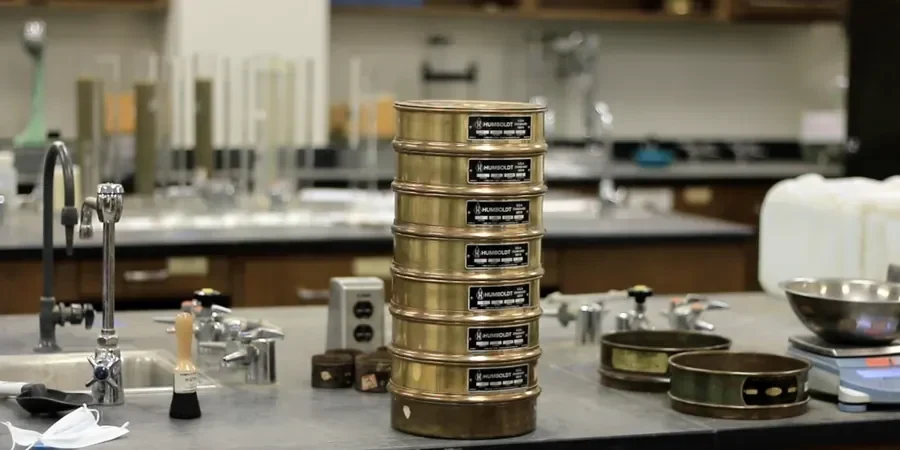
The stack of brass sieves sits on the Ro-Tap shaker, a familiar sound in any materials lab. For the silty sands and glacial tills common across Kelowna, the full picture doesn't emerge from sieves alone. That's where the hydrometer cylinder comes in. Suspended in a temperature-controlled water bath, a 152H hydrometer measures the settling velocity of fines over a 24-hour period, extending the gradation curve down to the clay fraction. In our work across Kelowna's benchlands and lakeshore terraces, we run combined sieve and hydrometer analyses on virtually every sample, because the difference between a well-graded sand and a gap-graded silty sand dictates everything from compaction behavior to frost susceptibility under the city's wet winters. For deep foundation design in the alluvial fans near Okanagan Lake, we often pair this with CPT testing to correlate fines content with sleeve friction readings directly.
The hydrometer analysis reveals the fines fraction that the naked eye misses, and in Kelowna's layered glaciofluvial soils, that hidden silt percentage often dictates the entire foundation strategy.
Regional considerations
One thing we see repeatedly in Kelowna's lower Mission and Rutland areas is that contractors assume a 'sandy' site based on a quick field examination, only to hit a silty layer at depth that holds pore water like a sponge. Without the hydrometer portion of the grain size analysis, that silt fraction stays invisible. The practical consequence? A spec that calls for a free-draining backfill might end up with material that retains water, freezes, and heaves against a foundation wall. The fines content from a full sedimentation analysis is also the starting point for assessing liquefaction potential in the sandy zones near Mill Creek, where the water table sits high. We've seen grain size curves from the same lot shift from 8% to 22% fines within two meters of depth, which completely changes the USCS classification and the corresponding design parameters. The hydrometer data is not an academic exercise; it directly informs whether you need subdrainage, a deeper footing embedment, or a more solid retaining wall drainage system.
Common questions
What does a grain size analysis with hydrometer cost in Kelowna?
For a combined sieve and hydrometer analysis on a single sample, budget between CA$150 and CA$280 depending on the maximum particle size and whether the sample requires oven drying and splitting. Turnaround is typically 5 to 7 business days.
Why do I need the hydrometer portion if my soil looks sandy?
The hydrometer quantifies the silt and clay fraction passing the No. 200 sieve, which controls drainage, frost heave susceptibility, and cohesion. In Kelowna's glaciofluvial deposits, a 'sandy' soil in the field often contains 10% to 25% fines that significantly alter its engineering behavior and USCS classification.
How is the hydrometer analysis performed step by step?
A 50-gram dried sample passing the No. 10 sieve is mixed with a sodium hexametaphosphate dispersant and soaked overnight. The slurry is then transferred to a sedimentation cylinder, agitated, and a 152H hydrometer is read at timed intervals over 24 hours. Temperature corrections are applied, and the particle diameter is calculated using Stokes' law based on settlement depth and elapsed time.
Can you run the test on gravelly samples from the Black Mountain area?
Yes. Samples with gravel are first processed through coarse sieves, and the portion passing the No. 4 or No. 10 sieve is split for hydrometer sedimentation. The final gradation curve combines the sieve data for the gravel and sand fractions with the hydrometer data for the fines, giving a complete particle size distribution for the entire sample.