← Home · Investigation

SPT (Standard Penetration Test) in Kelowna — ASTM D1586 Compliant

Together, we solve the challenges of tomorrow.

DETAILS →

A six-storey mixed-use project on Harvey Avenue hit refusal on a dense till layer at 14 metres. The contractor had assumed bedrock would be deeper based on a neighbouring site three blocks away. That assumption nearly doubled the piling budget before our rig arrived. Kelowna's subsurface is like that—glacial lake silts draped over irregular till, with buried channels that can shift bearing strata by several metres across a single city lot. We run the SPT in Kelowna to map those transitions precisely. Each blow count tells us whether we are in compressible silt, dense till, or something in between. For sites near the lake or along Mill Creek, we often pair the SPT with a grain-size analysis to confirm fines content, which directly affects liquefaction susceptibility under the NBCC seismic provisions.

N-value variability across a single Kelowna lot can exceed 30 blows within 3 vertical metres. That is the difference between a spread footing and a deep pile.

Method and coverage

Kelowna sits in a semi-arid valley where summer temperatures routinely exceed 35 °C and winter brings freeze-thaw cycles down to about 1.2 metres depth. Those thermal swings matter for SPT interpretation. Moisture content in the upper silts changes seasonally, and a blow count taken in saturated October conditions will differ from one logged in dry August soil. Our crew runs the test with an automatic trip hammer calibrated to 60% energy efficiency, recording N-values every 150 mm through the full 450 mm drive. We log recovery, colour, moisture, and consistency directly on the field boring log, referencing ASTM D2488 for visual-manual classification. When the split spoon comes up with grey varved silts—classic Okanagan lake-bottom sediment—we flag it immediately for the geotechnical engineer. In deeper deposits near the airport, where sand layers appear below 20 metres, the SPT data feeds directly into bearing capacity calculations using Meyerhof or Bowles methods. For projects requiring continuous stratigraphic profiles without sample disturbance, we recommend complementing the SPT with a cpt-test across selected borehole locations.
SPT (Standard Penetration Test) in Kelowna — ASTM D1586 Compliant
Technical reference image — Kelowna

Regional considerations

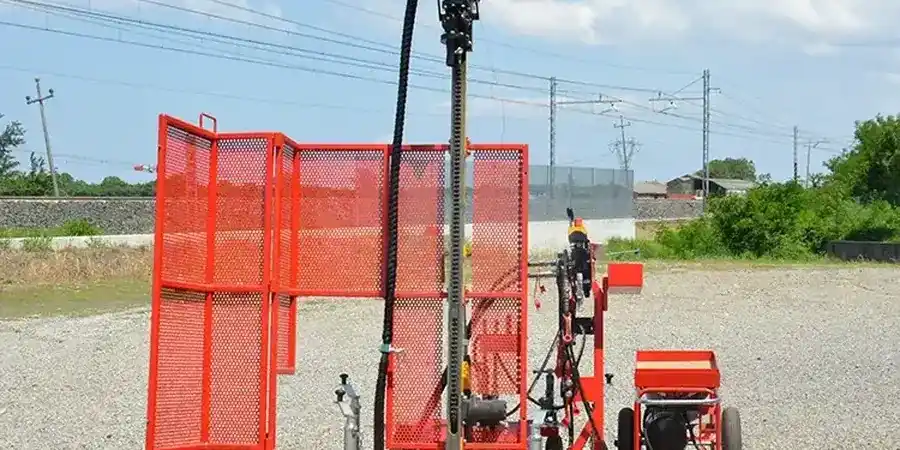
The CME-55 drill rig we run in Kelowna weighs close to 8 tonnes and sits on a tracked carrier that handles the sloping terrain common in the Upper Mission and Dilworth Mountain areas. Access is the first thing we assess. A tight backyard with a 1.2-metre gate means the rig stays on the street and we switch to hand-augered starter holes. The bigger risk is misinterpreting refusal. True refusal on a competent till sounds different than a cobble bouncing the split spoon—the hammer rings, penetration stops abruptly, and the rod torque spikes. We log that distinction because calling refusal on a boulder at 6 metres when till extends to 10 metres leads to an unconservative foundation design. In Kelowna's known liquefiable zones—particularly along the Mission Creek floodplain—a low N-value in saturated fine sand below the water table demands immediate attention. We run the SPT with care through those layers, counting every blow because the NCEER simplified procedure for liquefaction triggering depends entirely on that number.

Need a geotechnical assessment?

Reply within 24h.

Email: contact@geotechnicalengineering.xyz

Technical parameters


ParameterTypical value
Hammer typeAutomatic trip, 63.5 kg
Drop height760 mm ± 10 mm
Energy ratio (Er)60% (ASTM D1586 calibrated)
Drive interval recordingEvery 150 mm (6 in) for 450 mm total
SamplerStandard split spoon (50.8 mm OD)
Borehole diameter100–150 mm (hollow stem auger)
N60 correctionApplied per Seed & Idriss (1985) and Youd et al. (2001)

Complementary services

01

SPT Borehole Drilling and Sampling

Hollow stem auger drilling with split spoon sampling at 1.5-metre intervals or at stratum changes. Includes field logging per ASTM D2488, sample recovery measurement, and N-value recording on standardized boring logs.

02

N60 Energy-Corrected SPT Data Package

Raw N-values corrected for hammer energy ratio, rod length, borehole diameter, and overburden pressure. Delivered as a spreadsheet with plotted N60 versus depth, ready for direct input into bearing capacity and settlement calculations.

03

SPT-Based Liquefaction Screening

Application of the NCEER simplified procedure to SPT data from saturated granular layers. We compute CSR and CRR per Youd-Idriss (2001), producing factor of safety profiles for sites within Kelowna's NBCC-designated seismic hazard zones.

Standards that apply


ASTM D1586-18 — Standard Test Method for Standard Penetration Test (SPT) and Split-Barrel Sampling of Soils, ASTM D2488-17e1 — Standard Practice for Description and Identification of Soils (Visual-Manual Procedure), NBCC 2020 — National Building Code of Canada, Part 4, Division B (Seismic Hazard and Foundation Provisions), CSA A23.3:19 — Design of Concrete Structures (reference for foundation concrete), NCEER/NSF (Youd et al., 2001) — Liquefaction Resistance of Soils: Summary Report

Common questions

How much does an SPT borehole cost in Kelowna?

A single SPT borehole to 15 metres depth in the Kelowna area typically ranges from CA$670 to CA$1,060, depending on access conditions, traffic control requirements, and whether the hole is vertical or angled. Deeper holes beyond 25 metres or sites requiring all-terrain rig mobilization in the Upper Mission or lakeshore areas fall at the upper end of that range. Every quote includes the drilling crew, automatic hammer, split spoon sampler, field logging, and the N60-corrected data package.

How deep do you typically drill SPT boreholes in Kelowna?

Most commercial and residential projects in Kelowna require boreholes between 12 and 25 metres. Shallow holes to 10 metres suffice for single-family footings on the benches, while multi-storey buildings along the lakefront or in the downtown core often need 25 metres or more to penetrate through the glaciolacustrine silts and into competent till or bedrock. We determine the target depth based on the structural loads and the proximity to known buried channels mapped in provincial geological surveys.

What is the difference between raw N and N60?

Raw N is the blow count read directly from the field log—the number of hammer drops to drive the split spoon 300 mm after seating. N60 is the same count corrected to a reference energy ratio of 60%, which is the standard assumed in most empirical correlations. Our automatic hammer delivers an energy ratio measured during calibration, and we apply that correction along with factors for rod length, borehole diameter, and overburden pressure. An uncorrected N of 22 in a deep silt layer might become an N60 of 16 after adjustments—that shift changes the bearing capacity output significantly.

Do you need traffic control for SPT drilling on Kelowna streets?

Yes, any borehole located within the municipal right-of-way on streets like Pandosy, Richter, or Gordon requires a street occupancy permit from the City of Kelowna and a traffic management plan. We coordinate the lane closure setup with our subcontractor, who provides certified traffic control personnel, signage, and barricades compliant with the BC Traffic Management Manual. The permitting process typically adds three to five business days to the mobilization timeline.
Location and service area

We serve projects across Kelowna and its metropolitan area.

View larger map