← Home · Laboratory

Proctor Testing in Kelowna: Standard and Modified Compaction for Site-Ready Fill

Together, we solve the challenges of tomorrow.

DETAILS →

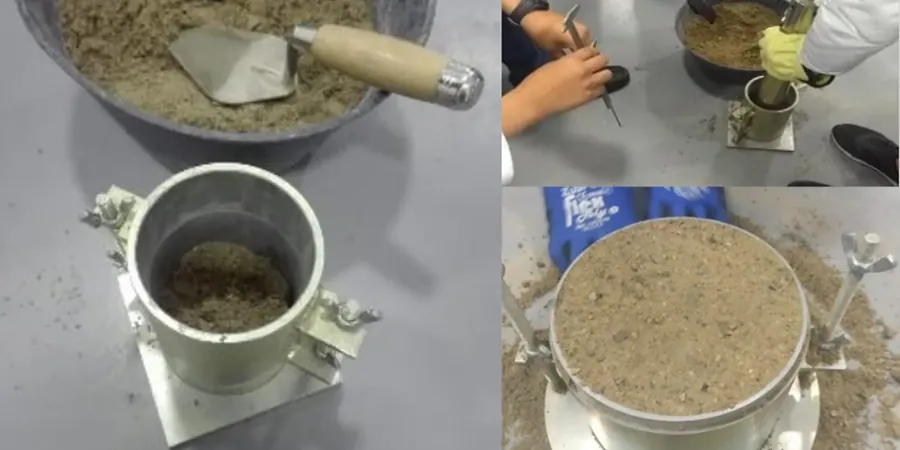
The mechanical hammer drops 12 inches. Exactly 25 blows per lift. The technician counts each impact while rotating the mold—Kelowna's glacial lake sediments demand precision. We run both Standard and Modified Proctor tests from our mobile lab, parked right at your cut station off Highway 97 or up in the Ellison hills. Okanagan soils shift from silty clay to sandy gravel in under 100 meters. A single assumed density number won't hold. Our team correlates maximum dry density and optimum moisture content directly to your borrow source, not a textbook value. For subdivision earthworks in Glenmore or commercial pads near the airport, we pair grain-size analysis with every compaction curve to flag gap-graded material before it hits the lift. The Modified Proctor applies 56,000 ft-lbf/ft³ of compactive effort—right for structural fill under a winery foundation or a retaining wall along the lake. Standard Proctor at 12,400 ft-lbf/ft³ suits landscape berms and utility trench backfill. Different energy, different density target, same lab calibration checked against ASTM D698 and D1557 every project.

A 2% moisture deviation from optimum can drop compaction by 5 percentage points—enough to trigger a re-compaction directive from the geotechnical inspector.

Method and coverage

Waterfront projects along Okanagan Lake demand a different compaction approach than the upper benches near UBCO. Lakeshore fill typically sits on soft silt; over-compacting with Modified Proctor can shear the subgrade. We dial in moisture conditioning and layer thickness to match the natural water table. Up on the Rutland plateau, the glacial till is gravel-dominant. Standard Proctor often underestimates achievable density there—your pad could settle 2 to 3 inches over five years if you use the wrong curve. The difference isn't academic. It's a cracked slab or a warranty claim. Our field crew checks lift thickness with a probe every 30 cubic meters during placement verification. For engineered fill under mat foundations, we cross-reference Proctor results with sand-cone-density tests on the same lift to confirm relative compaction above 95%. When the spec calls for 98% Modified Proctor density under a bridge approach off Harvey Avenue, we run side-by-side moisture-density relationships on material from the same truckload. No lab-standard soil—your soil, your compaction curve. The lab report delivers zero air voids curves, moisture-density plots, and a recommendation on acceptable moisture range for the contractor's water truck operator.
Proctor Testing in Kelowna: Standard and Modified Compaction for Site-Ready Fill
Technical reference image — Kelowna

Regional considerations

A commercial greenhouse project in the Belgo area hit a problem last season—three feet of imported fill, compacted without a Proctor baseline. Density tests showed 88% relative compaction against the structural spec of 95%. The contractor had to strip, moisture-condition, and re-compact the entire pad. Cost: two weeks of downtime and a $40,000 change order. Kelowna's semi-arid climate makes moisture control tricky. Fill dries fast in July and August. A Proctor curve defines the target, but it only works if the field crew hits the moisture window. Too dry, and the soil crumbles under the roller. Too wet, and you get pumping and rutting. We run a quick moisture check with a field microwave or a Speedy meter before the nuclear gauge goes on the lift. That sequence—Proctor curve first, moisture adjustment second, density test third—keeps the inspector off your back and the compaction record clean. For deep fills over 2 meters, we recommend re-running the Proctor every 1,200 cubic meters or whenever the borrow source changes color.

Need a geotechnical assessment?

Reply within 24h.

Email: contact@geotechnicalengineering.xyz

Technical parameters


ParameterTypical value
Test MethodsASTM D698 (Standard Proctor), ASTM D1557 (Modified Proctor)
Compactive Effort (Standard)12,400 ft-lbf/ft³ (600 kN-m/m³)
Compactive Effort (Modified)56,000 ft-lbf/ft³ (2,700 kN-m/m³)
Mold Volume1/30 ft³ (944 cm³) standard; 6-inch mold for oversize correction
Hammer Mass5.5 lb (2.5 kg) Standard; 10 lb (4.54 kg) Modified
Drop Height12 in (305 mm) Standard; 18 in (457 mm) Modified
Material SuitabilityUp to 30% retained on 3/4-inch sieve; oversize correction per ASTM D4718
Typical Turnaround24–48 hours; same-day available for time-sensitive lifts

Complementary services

01

Standard Proctor Test (ASTM D698)

For landscape fill, utility trench backfill, and non-structural pads. Establishes baseline moisture-density relationship at 12,400 ft-lbf/ft³ compactive effort. Includes zero air voids curve and optimum moisture recommendation.

02

Modified Proctor Test (ASTM D1557)

For structural fill under foundations, bridge approaches, and retaining wall backfill. 56,000 ft-lbf/ft³ effort simulates heavy roller compaction. Report includes corrected density for oversize particles per ASTM D4718.

03

Field Compaction Verification Package

Proctor curve development plus on-site nuclear density testing and sand cone correlation. We sample from your active lift, run the Proctor overnight, and return next morning with the target density for the day’s compaction.

Standards that apply


ASTM D698-12: Standard Test Methods for Laboratory Compaction Characteristics of Soil Using Standard Effort, ASTM D1557-12: Standard Test Methods for Laboratory Compaction Characteristics of Soil Using Modified Effort, ASTM D4718-15: Standard Practice for Correction of Unit Weight and Water Content for Soils Containing Oversize Particles, BC Building Code 2018, Division B, Part 4 (Geotechnical Design), MMCD (Master Municipal Construction Documents) Section 31 23 33
Common questions

What does a Proctor test cost in Kelowna for a single-family lot?

A Standard Proctor test for a single-family residential lot typically runs between CA$130 and CA$200. Modified Proctor ranges from CA$220 to CA$320 depending on oversize corrections and whether we sample from your site or you deliver the material to our lab. Field verification packages with nuclear density testing are quoted per day.

How many Proctor curves do I need for a subdivision with three borrow pits?

At least one Proctor curve per distinct material source. If the three borrow pits produce visually different soil—say, one is silty sand, another is clayey gravel, and the third is crushed rock—you need three separate curves. We also re-run the Proctor when the gradation shifts mid-borrow, which happens frequently in Okanagan glacial deposits.

Can I use the Standard Proctor instead of Modified to save money on a commercial pad?

Only if the geotechnical engineer of record specifies Standard Proctor for your project. Switching methods changes the compaction target significantly—Standard Proctor maximum dry density is typically 5 to 10 percent lower than Modified for the same soil. Using the wrong method under a structural slab risks differential settlement and a non-compliant inspection report.

Location and service area

We serve projects across Kelowna and its metropolitan area.

View larger map